
“We’re not political here.”
I’ve heard that sentence hundreds of times over the years. It usually comes from well-intentioned leaders who are proud of the culture they’ve built. To them, politics means gossip, backstabbing, empire building and people advancing themselves at the expense of others. If that’s organisational politics, then of course they don’t want it.
But every time I hear someone describe their organisation as “not political”, I become curious.
Not because I think they’re wrong about their people, but because they’re probably overlooking something far more significant.
Every organisation is political.
Not because people are manipulative. Not because there are hidden agendas around every corner. Simply because organisations are made up of human beings with different priorities, different responsibilities and different ideas about what should happen next. Wherever those differences exist, influence matters. And wherever influence matters, politics is already present.
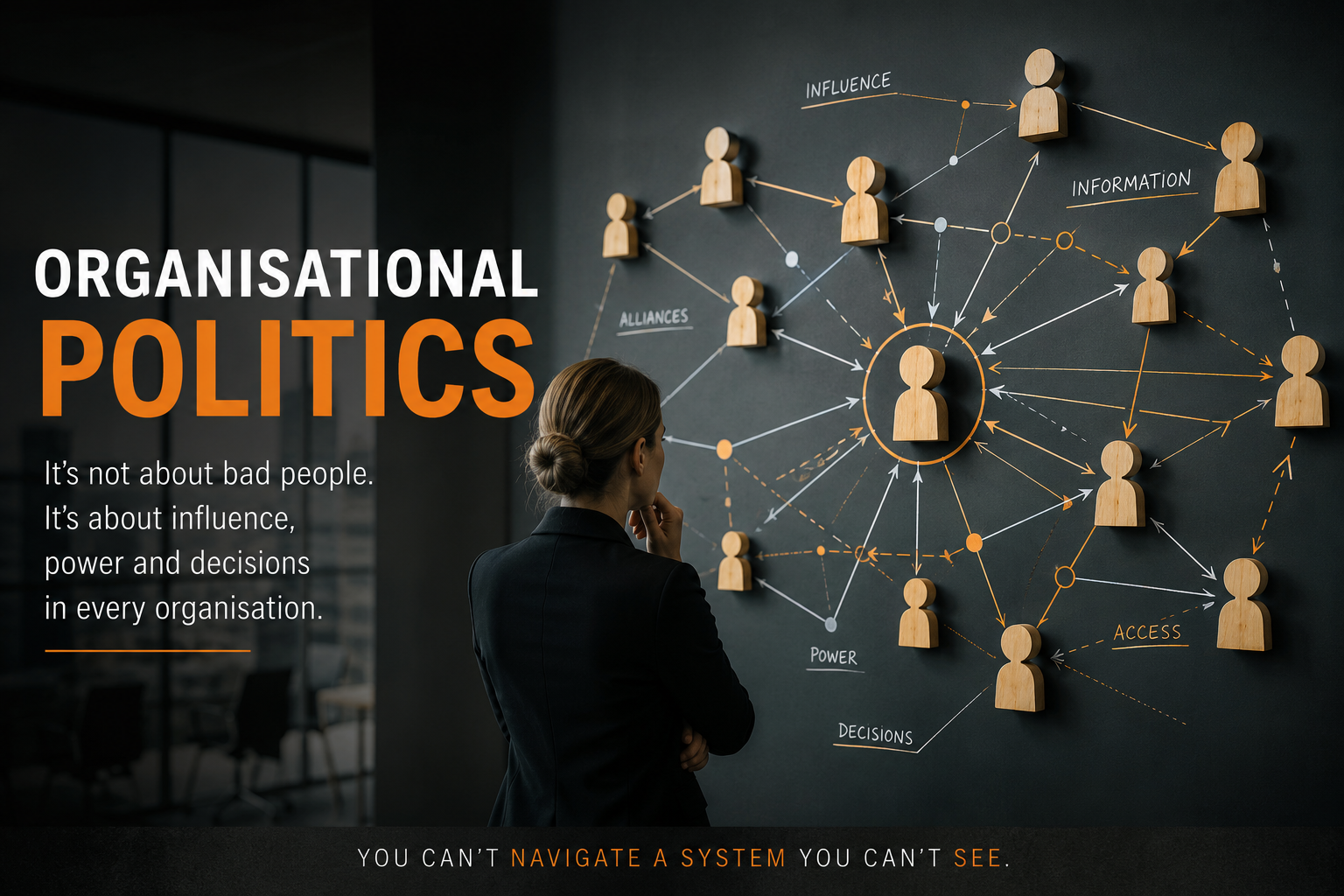
The problem isn’t politics itself. The problem is that we’ve allowed the word to become synonymous with unethical behaviour. As a result, many leaders reject the very idea of organisational politics, believing that if they don’t acknowledge it, they’ve somehow risen above it.
Unfortunately, the opposite is often true.
In my experience, the organisations most likely to describe themselves as “not political” are often the ones where political dynamics are least understood. The rules haven’t disappeared – they’ve simply become invisible. Decisions are still influenced. Alliances still form. Some voices still carry more weight than others. Resources are still negotiated, priorities still compete, and reputations still shape outcomes. The difference is that nobody talks about it.
That’s where problems begin.
Politics Isn’t the Problem—It’s a Normal Part of Organisational Life
When most people hear the phrase workplace politics, they immediately picture behaviour they dislike. Office gossip. Hidden agendas. Favouritism. People taking credit for someone else’s work. While those things certainly exist, they aren’t what politics actually is. They’re examples of people using influence unethically.
Politics, in its simplest sense, is what happens whenever people with different interests, perspectives and responsibilities have to make decisions together.
Think about your executive team for a moment.
The Chief Financial Officer wants to reduce costs. The Head of Sales is pushing for investment in growth. Operations wants stability. HR is advocating for capability development. Every one of them is acting in what they believe are the organisation’s best interests, yet each is viewing the situation through a different lens.
How do they reach a decision?
They don’t simply compare spreadsheets and choose the mathematically correct answer. They advocate. They negotiate. They build support. They frame their arguments. They draw on relationships, credibility, expertise and timing. In other words, they influence.
That’s politics.
Not dirty politics.
Not manipulative politics.
Simply the natural process of people navigating competing priorities in a complex system.
The same dynamic exists at every level of an organisation. Teams compete for limited budgets. Projects vie for executive attention. Managers balance organisational goals against the needs of their people. Colleagues persuade one another to support an idea or change direction. None of this is evidence of a dysfunctional culture. It’s evidence that human beings are working together.
The irony is that many leaders happily invest in communication skills, negotiation skills and stakeholder management while insisting their organisation isn’t political.
Those are all political skills.
We’ve simply chosen language that feels more comfortable.
Every Organisation Has a Political Operating System
One of the reasons politics is so often misunderstood is that we tend to look for it in people’s behaviour instead of in the system itself.
We notice the colleague who seems to have the CEO’s ear. We complain about someone receiving a promotion we didn’t expect. We wonder why one project is approved while another quietly disappears. We observe the symptoms, but rarely stop to ask what they reveal about the organisation around them.
Every organisation develops its own political operating system.
Some of it is formal. Organisation charts, reporting lines, governance structures and delegated authority all shape how decisions are made. But alongside those formal structures sits another system – one that is rarely documented, yet often has just as much influence.
It’s the system of unwritten rules.
Who can challenge a senior leader without damaging their reputation? Which teams are consistently listened to? Who is invited into important conversations before the meeting even begins? Which behaviours are quietly rewarded, even if they don’t align with the stated organisational values?
These aren’t questions you’ll find answered in an employee handbook.
Yet ask someone who has worked in an organisation for a few years, and they’ll usually answer them without hesitation.
That’s because people don’t just learn how an organisation works through induction programs or policy manuals. They learn by watching. They notice who receives opportunities, who is trusted with high-profile projects, whose mistakes are forgiven, and whose aren’t. They observe which ideas gain traction and which never seem to leave the meeting room.
Over time, those observations become an internal map of the organisation.
Most people couldn’t articulate that map if you asked them to. But they use it every day.
The Gap Between Stated Culture and Lived Culture
This is where organisational politics and organisational culture become inseparable.
Almost every organisation has a beautifully written set of values. They talk about collaboration, innovation, accountability, courage or respect. Those values are important because they describe the culture leaders aspire to create.
Employees, however, pay closest attention to something else.
They watch what actually gets rewarded.
Imagine an organisation that proudly declares innovation as one of its core values, yet every unsuccessful experiment is met with blame and criticism. Before long, people stop taking risks. The organisation hasn’t lost its innovative values – it has simply created a political environment where playing it safe carries fewer consequences than trying something new.
Or consider the organisation that encourages employees to “speak up”. On paper, everyone has a voice. In practice, people who challenge senior leaders are labelled as difficult, while those who quietly agree are described as collaborative.
Again, the political system has overridden the stated culture.
The same thing happens when organisations claim to value collaboration but consistently reward individual heroics, or promote transparency while allowing important decisions to be made behind closed doors.
People don’t build their understanding of culture from posters on the wall.
They build it from patterns.
Every promotion, every recognition program, every executive decision and every difficult conversation sends a signal about what the organisation genuinely values.
Those signals become the real culture.
And those signals are political.
Why Good Leaders Miss It
One of the greatest misconceptions about organisational politics is that only ambitious or manipulative people need to understand it.
In reality, some of the people most disadvantaged by organisational politics are highly capable, deeply ethical leaders.
They’re excellent at building relationships. They care about their teams. They work hard. They consistently deliver results.
What they often assume, however, is that the quality of their work will naturally speak for itself.
Sometimes it does.
Often it doesn’t.
I’ve coached countless leaders who found themselves frustrated because they couldn’t understand why someone with less experience, less capability or weaker results seemed to have greater influence. Their first instinct was to question themselves. Maybe they needed another qualification. Maybe they needed to become more confident. Maybe they simply needed to work harder.
Occasionally that was true.
More often, they were trying to solve a political problem with a performance solution.
They weren’t failing because they lacked competence.
They were failing because they hadn’t yet learned to read the environment they were operating within.
That’s a very different challenge.
When we don’t understand the political system around us, we tend to personalise experiences that are actually systemic. We assume we’ve done something wrong when, in reality, we’ve misunderstood the unwritten rules shaping how influence works in that particular organisation.
That’s one of the reasons I became so interested in Political Intelligence.
After years of working with organisations across different sectors, I realised that technically brilliant leaders were often struggling for the same reason. They had developed emotional intelligence, strategic thinking and strong leadership capability, yet nobody had taught them how to interpret the political landscape they were working in.
They weren’t lacking integrity.
They were lacking a map.
Political Intelligence Starts With Seeing What Others Miss
That realisation changed the way I thought about leadership development.
For years, organisations have invested heavily in helping leaders communicate more effectively, build emotional intelligence and develop strategic thinking. All of those capabilities matter, and I continue to believe they’re essential. But I began to notice there was still something missing.
Leaders were being taught how to lead people.
Very few were being taught how to read systems.
Time and again, I’d watch talented, well-intentioned leaders become frustrated because they couldn’t understand why good ideas stalled, why some stakeholders seemed impossible to influence, or why identical behaviours produced completely different outcomes in different organisations.
The advice they received was almost always the same: communicate more clearly, build stronger relationships, become more confident.
Useful advice – but often incomplete.
Because before you decide how to influence, you first need to understand where you’re trying to influence.
That’s the thinking that led me to develop the Political Intelligence Compass™.
The Compass isn’t designed to teach people how to “play politics”. It’s designed to help them read the political landscape they already work within. Like a topographical map, it helps leaders see the terrain before deciding which path to take.
Every organisation rewards certain behaviours and discourages others. Every workplace has formal structures alongside informal networks. Every team has people who hold influence because of their expertise, their relationships, their reputation or simply because others trust their judgement. Until you can see those dynamics clearly, you’re navigating with only half the information.
Political Intelligence begins with observation before action.
It asks different questions.
Instead of asking, “How can I be more influential?”, it asks, “What is this environment responding to?”
Instead of assuming that resistance means someone is difficult, it asks, “What incentives or pressures might be shaping their behaviour?”
Instead of taking every setback personally, it asks, “Is this really about me, or am I encountering a system that rewards something different?”
Those questions don’t make leaders more political.
They make them more perceptive.
Influence Doesn’t Happen in a Vacuum
One of the simplest ways I’ve found to explain this is through what I call The Influence Equation™.
Influence is rarely determined by competence alone.
It’s shaped by three interconnected factors:
Position – the authority, role and decision rights you formally hold.
Perception – how others interpret your credibility, intent and judgement.
Permission – the unwritten rules that determine what the organisation is prepared to accept from someone in your position.
Most leadership development focuses almost entirely on the first two.
Improve your capability.
Strengthen your communication.
Build credibility.
All worthwhile.
But the third factor – permission – is where organisational politics quietly lives.
Think about two leaders who challenge a proposal in exactly the same way.
One is described as courageous and strategically minded.
The other is labelled difficult or disruptive.
The behaviour is almost identical.
The outcome is completely different.
Why?
Because influence is always interpreted within context.
Every organisation has invisible boundaries around what is considered acceptable, credible or risky. Those boundaries aren’t fixed. They shift according to relationships, history, organisational culture and power dynamics.
Ignoring those dynamics doesn’t make them disappear.
It simply makes them harder to navigate.
That’s why Political Intelligence isn’t about becoming someone you’re not.
It’s about understanding the environment well enough to choose the most effective and most ethical way to move within it.
In my experience, that’s an important distinction.
Manipulation narrows other people’s choices to increase your own advantage.
Political Intelligence expands your understanding so you can make better choices without compromising your integrity.
The goal isn’t to become better at office politics.
The goal is to become better at reading organisations.
Perhaps the Question Isn’t Whether Your Organisation Is Political
After spending more than three decades working with organisations, I’ve come to believe we’re asking the wrong question.
Instead of asking whether an organisation is political, we should be asking whether its politics are visible, ethical and understood.
Because politics isn’t an unfortunate by-product of organisational life.
It’s the mechanism through which decisions are made, priorities are negotiated, resources are allocated and change either succeeds or fails.
When leaders pretend politics doesn’t exist, they don’t eliminate it. They simply make it harder to recognise. The informal networks become more influential than the formal ones. Decisions appear inconsistent. Capable people become frustrated because they can’t make sense of why one idea succeeds while another quietly disappears.
Eventually, people stop believing what the organisation says it values and start believing what they observe.
That’s when trust begins to erode.
The organisations I most enjoy working with aren’t the ones that have somehow escaped organisational politics. I’ve never found one.
They’re the organisations where leaders are willing to have honest conversations about how influence really works. They recognise that power isn’t inherently good or bad – it simply exists. Their responsibility is to ensure it’s exercised transparently, ethically and in service of better decisions rather than individual agendas.
That’s a very different proposition from pretending politics isn’t there.
Political Intelligence is ultimately about increasing awareness.
It helps leaders distinguish between personality and system, between individual behaviour and organisational patterns, between assumptions and evidence. It encourages curiosity before judgement and observation before action.
Perhaps most importantly, it reminds us that influence is not something we do in isolation. It emerges from the relationship between people and the systems they’re working within.
Once you begin to see those systems more clearly, many of the frustrations that once felt deeply personal start to make much more sense.
You stop asking, “Why won’t they listen to me?”
Instead, you ask, “What is this system rewarding, protecting or resisting?”
That’s a far more useful question.
Because when you understand the system, you have far more choices about how to influence it.
And that’s what Political Intelligence is really about.
Not learning to play the game.
Learning to read it.
Ready to See Your Organisation Through a Different Lens?
If this article has challenged the way you think about workplace politics, the next step is learning how to recognise the hidden dynamics shaping influence in your own organisation.
The Political Intelligence Compass™ was developed to help leaders understand both their natural approach to influence and the political environment they’re operating within. Rather than teaching people how to “play politics”, it provides a practical framework for reading organisational dynamics more accurately, making better strategic decisions and influencing with integrity.
Because you can’t navigate a landscape you can’t see.
And the most influential leaders aren’t necessarily the loudest, the most senior or the most charismatic.
They’re the ones who understand the terrain well enough to know which move to make next.
About the Author
Rosalind Cardinal is a leadership strategist, author, and founder of Shaping Change, an award-winning consultancy helping leaders and organisations build cultures where people and performance thrive. With a background in organisational development and neuroscience-based coaching, Ros works with boards, executives, and teams to create lasting change through clarity, courage, and connection.
Book a chat with Ros.
Read next: Conflict System Design: Why Great Leaders Fix The System, Not Just The Conflict