
Conflict is often treated as a people problem.
When tensions rise, relationships become strained, or teams struggle to work together, organisations frequently respond by investing in conflict resolution training. Leaders are taught how to have difficult conversations, provide feedback, and manage disagreements more effectively.
While these skills are valuable, they often address only the symptoms of a much deeper issue.
The real question leaders should be asking is this:
What if the conflict isn’t being caused by the people at all?
What if the conflict is being created by the way the organisation itself is designed?
This is where the concept of conflict system design becomes important.
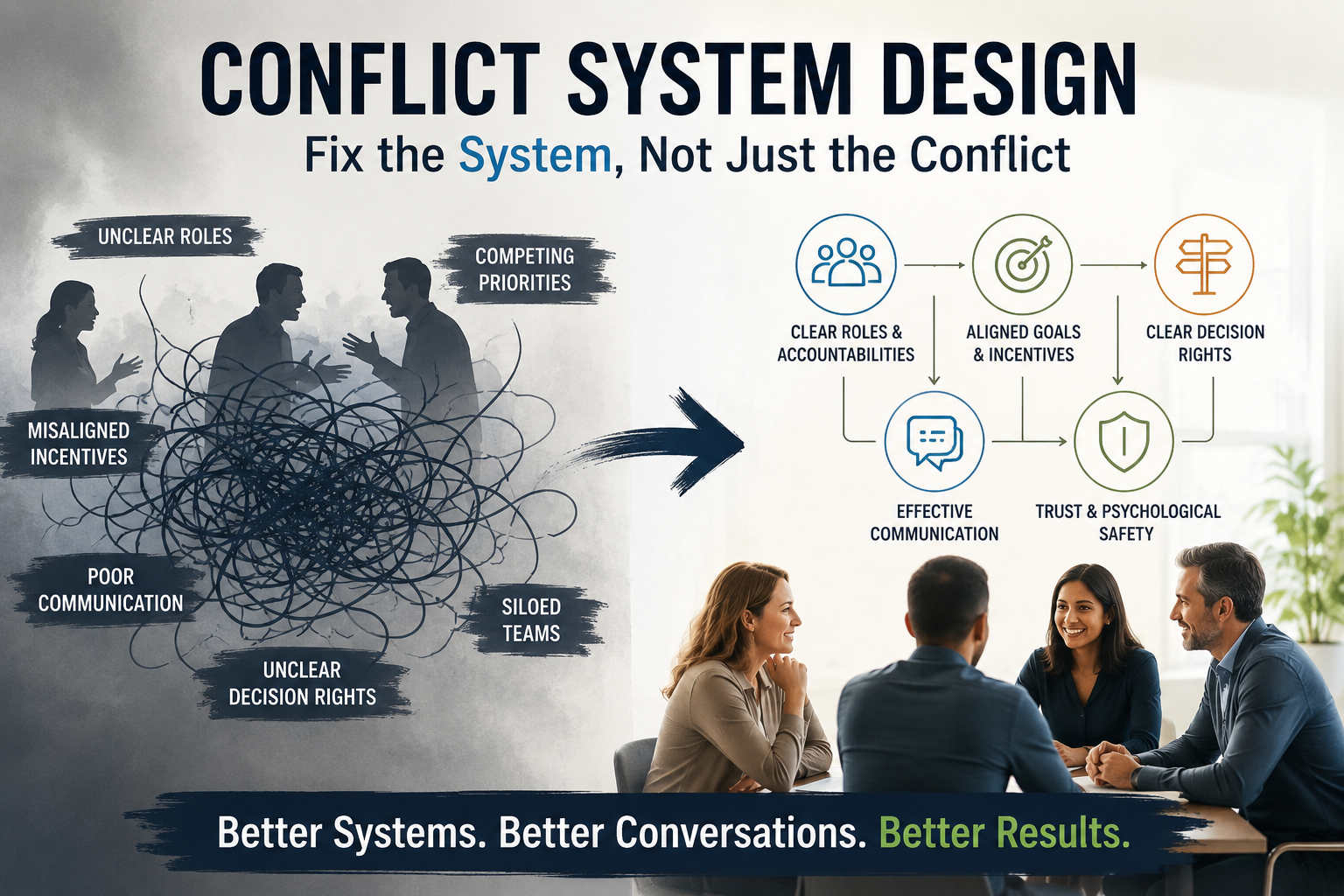
What Is Conflict System Design?
Conflict system design focuses on creating organisational structures, processes, and cultures that reduce unnecessary conflict before it occurs.
Rather than asking, “How do we help people resolve conflict?” conflict system design asks:
- What conditions are creating this conflict?
- What systems are reinforcing it?
- What organisational design choices are making conflict inevitable?
In other words, conflict system design addresses the root causes of conflict rather than simply helping people manage the consequences.
Conflict Resolution vs Conflict System Design
Many organisations invest heavily in conflict resolution skills while overlooking the systems that continually generate conflict.
Consider the difference:
Conflict Resolution
- Teaches communication skills
- Improves feedback conversations
- Supports mediation and negotiation
- Helps individuals navigate disagreement
- Responds after conflict occurs
Conflict System Design
- Clarifies roles and accountabilities
- Aligns goals and incentives
- Improves decision-making processes
- Creates clear communication pathways
- Reduces avoidable conflict before it starts
Both approaches have value, but only one addresses the source of the problem.
Why Conflict Keeps Reappearing
One of the strongest indicators of a system issue is recurring conflict.
If the same disagreements continue to emerge despite coaching, workshops, and team-building activities, leaders should pause and investigate.
Ask yourself:
- Are responsibilities clearly defined?
- Do teams have competing priorities?
- Are decision-making authorities unclear?
- Are people rewarded for behaviours that undermine collaboration?
- Is information reaching the right people at the right time?
When these conditions exist, conflict becomes a predictable outcome of the system.
No amount of communication training can fully compensate for poor organisational design.
Three Common Examples of System-Generated Conflict
1 – Role Ambiguity
A manager and team leader constantly clash over decision-making.
The immediate assumption may be that they need better communication skills.
However, a closer examination reveals that both individuals believe they are accountable for the same outcomes.
The conflict is not interpersonal.
The conflict is structural.
When accountability and authority become clear, the tension often disappears.
2 – Competing KPIs
Marketing is measured on generating leads.
Operations is measured on efficiency and workload management.
Both teams are achieving their targets, yet conflict continues.
Why?
Because the organisation has unintentionally created competing objectives.
The system rewards behaviour that places the teams in opposition to one another.
Until the incentives are aligned, the conflict will persist.
3 – Lack of Psychological Safety
Leadership teams often report difficulty having honest conversations.
The response is frequently to provide training in courageous conversations or feedback techniques.
Yet leaders may still remain silent.
The reason?
The organisation’s culture may be teaching people that disagreement is risky.
If challenging ideas leads to criticism, exclusion, or career consequences, people quickly learn that staying quiet is the safer option.
The issue is not capability.
The issue is culture.
The Leadership Shift: From Blame to Curiosity
One of the most powerful shifts leaders can make is moving from blame to curiosity.
Instead of asking:
“Why are these people struggling to work together?”
Ask:
“What is it about our system that is making this conflict likely?”
This simple change in perspective can transform how leaders diagnose organisational challenges.
Conflict becomes valuable data rather than evidence of failure.
It highlights where structures, processes, incentives, or leadership practices may need attention.
What Leaders Should Examine First
Before investing in another conflict management workshop, consider conducting a simple systems review.
Look at:
Roles and Accountabilities: Are responsibilities clear, understood, and documented?
Goals and Incentives: Do teams win together or compete against one another?
Decision Rights: Is it clear who decides, who contributes, and who is informed?
Communication Systems: Do people have access to the information they need?
Leadership Behaviours: What behaviours are leaders modelling and rewarding?
Organisational Culture: Does the culture encourage healthy challenge and constructive debate?
These areas often reveal the hidden causes of recurring conflict.
A Powerful Diagnostic Question
When leaders are trying to determine whether conflict is a people issue or a system issue, one question is particularly useful:
If we replaced every person involved tomorrow, would the conflict eventually return?
If the answer is yes, the problem is probably not the people.
The problem is the system.
Final Thoughts
Conflict is not always a sign that people lack communication skills.
Often, it is a signal that the organisation’s structures, processes, incentives, or culture need attention.
Great leaders understand that sustainable change comes from addressing causes, not symptoms.
Conflict resolution skills remain important, but they should not be the only solution.
The organisations that thrive are those that invest in conflict system design—creating environments where collaboration is easier, accountability is clearer, and unnecessary conflict is far less likely to occur.
The next time conflict surfaces in your team, resist the urge to immediately ask, “Who needs training?”
Instead, ask:
“What is our system trying to tell us?”
About Ros Cardinal
Ros Cardinal is an organisational development consultant, executive coach, and creator of the Women’s Leader Archetypes and Political Intelligence Compass frameworks. Through leadership consulting, coaching, speaking, and The Archetype Effect podcast, she helps leaders navigate influence, culture, power, and human behaviour in complex workplaces.
Book a chat with Ros.
Read Next: AI Isn’t Replacing Leadership – it’s changing what leaders need to focus on
Uncover the true potential of your team with our two-minute Team Effectiveness quiz! Take the quiz now and gain access to the 7 crucial strategies used by successful leaders to inspire and motivate their teams.