
Artificial intelligence can analyse enormous amounts of information, identify patterns, generate options and produce sophisticated answers in seconds.
But can it exercise judgment?
And perhaps more importantly: what happens to human judgment when AI becomes the easiest source of an answer?
That question sits at the heart of one of the most important leadership challenges emerging from the rapid adoption of artificial intelligence.
Much of the conversation about AI and the future of work has focused on capability. What can AI do? Which tasks can it automate? Which jobs will change? How much productivity can organisations gain?
Those are important questions.
But for leaders, there is another question that deserves considerably more attention:
What happens to the quality of our thinking when answers become almost effortless to obtain?
I recently explored this question with researcher, author and former US intelligence professional Adrian Wolfberg in a Beyond the Book interview about his book, Who Leads When AI Thinks?
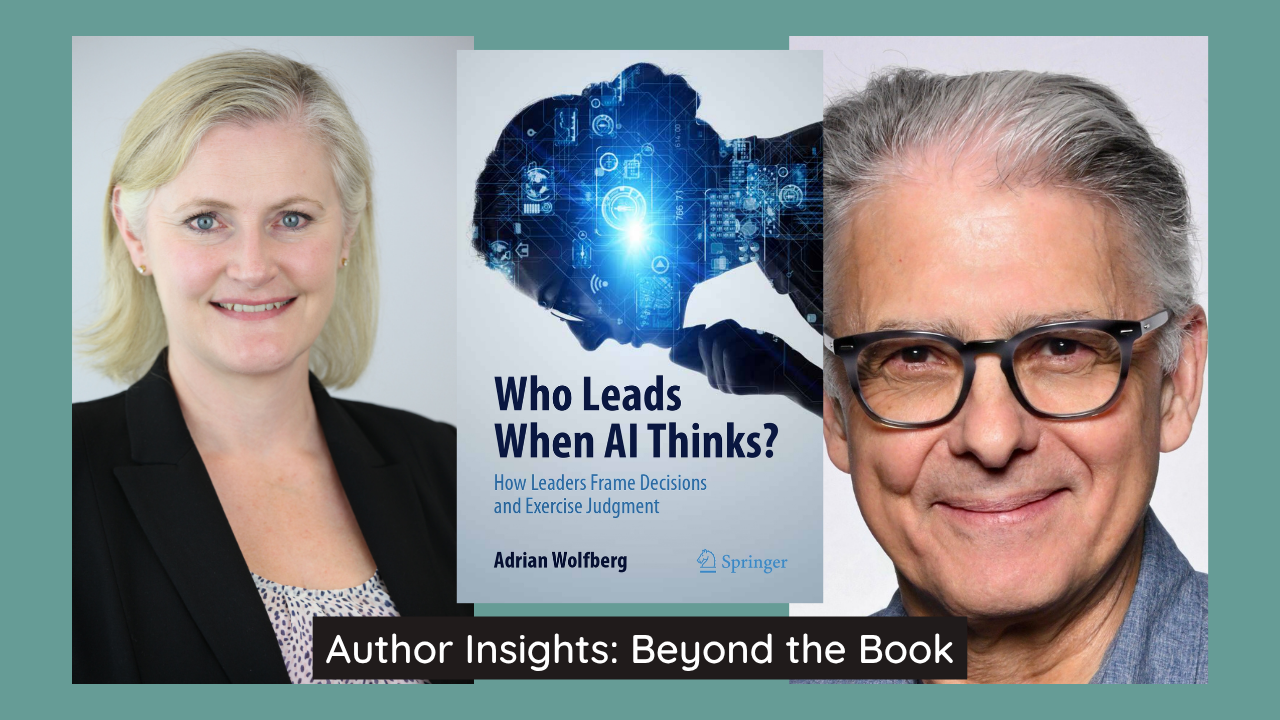
Wolfberg has spent more than four decades working at the intersection of national security, organisational behaviour, knowledge and decision-making under uncertainty. Our conversation moved well beyond AI technology and into something much more fundamental: the changing nature of leadership itself.
And one idea kept resurfacing.
The organisations that benefit most from AI may not be those that adopt it fastest.
They may be those whose leaders become better at knowing when to trust technology, when to challenge it, when to slow down and when human judgment must remain firmly in charge.
AI Can Make Organisations Faster. That Doesn’t Necessarily Make Them Wiser.
There is enormous organisational pressure to adopt AI quickly. Businesses are buying tools, automating processes, experimenting with agents and encouraging employees to incorporate generative AI into everyday work. The productivity opportunity is real.
But Wolfberg makes an important distinction:
AI capability without corresponding leadership capability may make an organisation faster, but not necessarily wiser. That’s worth sitting with.
AI drastically reduces the friction involved in generating an answer. A leader can describe a problem and receive recommendations almost instantly. They can ask for alternative strategies, analyse data, summarise reports, generate scenarios or develop implementation plans. The danger is subtle. Because an answer appears coherent, sophisticated and confident, we can mistake having an answer for understanding the problem.
Wolfberg describes this distinction as the difference between apparent understanding and earned understanding.
Apparent understanding feels convincing. Earned understanding requires work. It means interrogating assumptions. Understanding history. Listening to competing perspectives. Recognising political and relational dynamics. Testing interpretations. Considering consequences. And sometimes admitting:
We don’t understand this well enough yet to decide.
That capacity may become more important as AI becomes more capable, not less.
Intelligence and Judgment Are Not the Same Thing
One of the most useful distinctions from my conversation with Wolfberg was between intelligence and judgment. He describes intelligence as the capacity to generate, analyse and connect information.
Judgment is different. Judgment determines what that information means and what should be done about it. This distinction has enormous implications for leadership in the age of AI. AI is becoming extraordinarily capable at information processing. But leadership rarely occurs in situations where information alone provides an obvious answer.
Leaders operate in ambiguity.
Should we restructure the organisation?
Should we close a service?
Should we promote this person?
Should we invest in this market?
How should we respond to declining trust?
Should we push ahead with a transformation when employees are already exhausted?
Should we act now or wait?
There may be data informing each decision. But there is rarely an algorithmically perfect answer. There are competing priorities, histories, relationships, consequences and values. That is where judgment begins.
What Does Good Leadership Judgment Require?
Good judgment requires leaders to consider several dimensions simultaneously.
What do we know?
What don’t we know?
What assumptions are we making?
Whose perspective is missing?
What happened previously?
What has changed since then?
Who will be affected?
What unintended consequences could emerge?
And perhaps most importantly:
What is actually going on here?
That last question becomes particularly important because organisational problems rarely arrive neatly labelled. They arrive as symptoms.
Turnover increases.
Engagement declines.
Projects stall.
Meetings become tense.
Decisions take longer.
Teams become territorial.
Innovation slows.
A leader sees the symptom and understandably wants to solve it. But the visible problem may not be the actual problem.
AI Makes Problem Framing a Critical Leadership Skill
One of Wolfberg’s strongest arguments is that leaders need to become much better at problem framing. Before solving a problem, we need to understand what problem we’re actually solving. That sounds obvious. In practice, organisations get it wrong surprisingly often. Imagine an organisation experiencing declining performance.
Finance might see a cost problem.
Operations might see an inefficient process.
HR might see a capability issue.
Employees might see a trust problem.
Senior executives might see an accountability problem.
Each perspective may contain some truth. The danger occurs when the first, loudest or most powerful interpretation becomes the problem. Once that happens, everything downstream follows the frame.
The data we gather.
The people we consult.
The questions we ask.
And increasingly, the prompts we give AI.
This introduces a fundamental limitation that every leader using artificial intelligence needs to understand:
AI can help solve the problem you give it. It cannot guarantee that you have given it the right problem.
If the frame is wrong, AI may simply help us solve the wrong problem more efficiently. That makes problem framing one of the most important leadership skills in an AI-enabled organisation.
When Technically Correct Isn’t Good Enough
There is another dimension to leadership judgment that becomes increasingly important as organisations rely on AI. An answer can be technically correct and still be organisationally wrong. Organisations are not machines. They are human systems shaped by history, relationships, trust, power, identity, memory and meaning. This came up strongly during my conversation with Wolfberg because it intersects with something I see repeatedly in my own organisational development work.
Leaders may introduce an initiative that makes perfect rational sense. Yet people resist it. From the surface, that resistance can look irrational.
Dig deeper and you may discover that the organisation attempted something similar five years ago and it failed badly. Or employees were promised consultation previously and felt ignored. Or the initiative threatens the influence of a powerful stakeholder. Or a seemingly minor decision carries symbolic meaning because of the organisation’s history. None of this necessarily appears in the spreadsheet. But it profoundly affects whether the decision succeeds. This is why context matters.
As Wolfberg explained, judgment requires understanding not only current circumstances but the relationships, constraints, history and potential consequences surrounding them.
The technically optimal answer may therefore not be the wisest answer. Leadership requires understanding the difference.
The Human Leadership Skills That Become More Valuable Because of AI
The rise of artificial intelligence doesn’t necessarily diminish the importance of human capability. It changes which human capabilities create the greatest value.
As AI becomes better at processing information and generating answers, several leadership capabilities become increasingly important.
Judgment allows leaders to interpret information rather than simply receive it.
Contextual intelligence helps leaders understand the human system surrounding a decision.
Empathy enables leaders to recognise how decisions affect people’s dignity, trust, motivation and sense of safety.
Curiosity keeps leaders questioning their first interpretation.
Critical thinking enables them to challenge assumptions and evaluate AI-generated recommendations.
Moral responsibility ensures that accountability remains human.
And sensemaking helps people collectively understand situations where there is no single obvious interpretation.
These aren’t soft skills sitting around the edges of “real” leadership. Increasingly, they are the work of leadership.
Which Decisions Should Leaders Never Delegate to AI?
This was one of the questions I most wanted to ask Wolfberg. His answer was clear.
AI can support decisions involving human consequences. It should not own them.
When decisions affect people’s safety, opportunities, livelihoods or rights, leaders should not delegate moral responsibility to a machine.
That doesn’t mean AI shouldn’t be involved.
It might analyse information.
Identify patterns.
Challenge assumptions.
Generate scenarios.
Surface alternatives.
Highlight risks.
But ultimately someone must remain responsible for asking:
Is this fair?
Is this appropriate?
What consequences are we willing to accept?
What might we be missing?
Who carries the risk if we’re wrong?
Those aren’t simply analytical questions. They’re leadership questions.
And importantly, AI cannot be accountable. The leader can.
The Paradox of AI: Leaders May Need to Slow Down
Perhaps the most counterintuitive idea from our conversation was this:
As AI gets faster, leaders may need to get better at slowing down.
Not everywhere. Speed still matters. There are many situations where AI-enabled efficiency creates enormous value. But leaders need to recognise the moments when speed becomes dangerous.
Wolfberg argues that humans simply cannot understand information at the speed AI can generate it. That creates an asymmetry.
AI can generate an analysis.
Then another.
Then five alternatives.
Then a risk assessment.
Then an implementation plan.
Then objections to the implementation plan.
Within minutes, a leader can be surrounded by enormous amounts of plausible information. But information accumulation isn’t the same as understanding. At certain points, leaders need to stop.
Think.
Discuss.
Challenge.
Reflect.
And make sense of what they are seeing.
The emerging leadership capability isn’t simply moving fast. It is knowing when to move fast and when to slow down.
How Leaders Can Use AI as a Thinking Partner
None of this is an argument against using AI. Quite the opposite. Used thoughtfully, AI can become an extraordinary thinking partner.
Instead of simply asking:
“What should I do?”
leaders can use AI to interrogate their own thinking.
Try questions such as:
- What assumptions am I making?
- What alternative explanations could account for this situation?
- What evidence would contradict my interpretation?
- Which stakeholders might see this differently?
- What patterns might I be missing?
- What unintended consequences could follow this decision?
- What questions haven’t I asked?
- If my preferred solution failed, what would most likely have caused the failure?
Notice what these prompts do. They don’t outsource judgment. They expand it. AI becomes a challenger, pattern finder, scenario generator and thinking partner. The human remains responsible for interpretation. That’s a very different relationship with technology.
A Practical AI Leadership Habit to Try This Week
If you lead a team, there is a simple experiment you can try. The next time your team faces a meaningful problem, don’t start with AI. Start with the humans. Before anyone asks ChatGPT, Claude or another AI system for an answer, ask everyone to independently consider:
What do you think is actually going on?
Then explore:
What is the problem we’re trying to solve?
What assumptions are we making?
What don’t we understand?
What context matters?
Whose perspective might be missing?
What are we uncertain about?
Only then introduce AI. Ask it to challenge, expand or test the team’s thinking. This reverses a pattern I suspect we’re going to see increasingly often in workplaces: AI generates the first interpretation and humans react to it. Instead, humans establish the first frame. AI becomes what Wolfberg describes in our conversation as effectively the second thinker in the room. That small change protects something enormously valuable: our capacity to think for ourselves.
Leadership in the Age of AI Is Still Deeply Human
It would be easy to look at increasingly capable AI systems and conclude that human leadership will become less important. I suspect the opposite. AI can give leaders unprecedented access to information, analysis and recommendations. But it cannot remove the need for someone to interpret what those answers mean within a particular human system.
Someone still needs to understand context.
Someone still needs to notice what isn’t being said.
Someone still needs to recognise competing values.
Someone still needs to make decisions when the evidence is incomplete.
Someone still needs to understand how those decisions affect people.
And someone still needs to be accountable for what happens next.
That is leadership.
As Wolfberg said towards the end of our conversation, the leaders we need in an AI-enabled future will be less concerned with having all the answers and more capable of creating the conditions in which earned understanding can emerge.
Perhaps that is the paradox of leadership in the age of AI.
As machines become more capable of producing answers, the distinctly human work of asking better questions, making meaning, exercising judgment and accepting responsibility becomes more valuable.
AI may change how thinking gets done. It doesn’t remove our responsibility to think.
Watch the Full Conversation
My conversation with Adrian Wolfberg goes much deeper into these ideas, including human-AI collaboration, empathy, problem framing, contextual understanding, critical thinking and what leadership might look like over the next decade.
Watch the full Beyond the Book interview: Who Leads When AI Thinks?
Adrian Wolfberg’s book, Who Leads When AI Thinks?, explores these questions in considerably more depth and offers frameworks for thinking about the relationship between human and machine intelligence.
Adrian can be found on LinkedIn.
About the Author
Ros Cardinal is the Founder and Managing Director of Shaping Change, an Australian leadership and organisational development consultancy.
With almost 40 years’ experience in organisational development, executive coaching and leadership consulting, Ros helps leaders and organisations navigate the hidden dynamics that shape culture, influence, decision-making and performance.
She is the creator of the Recognition Pathway™, Political Intelligence Compass™, Organisational Hidden Ecology™ and the Women’s Leader Archetypes™ framework.
Book a chat with Ros.
Read Next: Why Good Work Doesn’t Always Lead to Recognition at Work