
Introducing the Recognition Pathway™
Most of us begin our careers believing that good work will naturally lead to recognition.
It seems like a reasonable assumption. If you consistently deliver high-quality work, solve difficult problems and contribute to the success of your team, surely the right people will notice. Surely opportunities will follow.
For a while, that often appears to be true.
Then something changes.
You find yourself watching a colleague being invited onto the strategic project you quietly hoped to lead. Someone else is promoted into the role you thought you were working towards. A new opportunity arises and your name never enters the conversation. It’s not that you feel overlooked every day, but every now and then there’s a moment that leaves you wondering, “What am I missing?”
What’s particularly confusing is that there isn’t an obvious explanation. Your performance is strong. Your relationships are positive. You’ve built experience, delivered results and earned the respect of the people you work with. From the outside, your career appears to be progressing exactly as it should.
Yet something doesn’t quite add up.
Over the past four decades, I’ve had countless conversations with leaders who describe this experience. They rarely begin by questioning their capability. More often, they’re trying to make sense of a disconnect between the work they’re doing and the opportunities they’re receiving. Somewhere along the way, the link between contribution and recognition seems to have weakened.
The most common conclusion is that they need to become more confident. Speak up more often. Develop greater executive presence. Learn to promote themselves.
Sometimes that’s the right answer.
More often, I don’t think it is.
I think we’ve been asking the wrong question.
The issue isn’t usually capability.
And it isn’t always confidence.
Often, it’s that we’ve misunderstood how recognition actually works inside organisations.
Until we understand that process, it’s easy to believe we’re being judged solely on the quality of our work. In reality, work is only the beginning of the story. Recognition follows a much more complex path—one that has less to do with how hard we work and far more to do with how our contribution is understood by other people.
We’ve Been Solving the Wrong Problem
When people feel overlooked at work, the advice they receive is often remarkably consistent.
“You need to speak up more.”
“You need greater executive presence.”
“You need to be more confident.”
There’s truth in all of those suggestions. Confidence can influence how we communicate, how we make decisions and how willing we are to put ourselves forward. But confidence alone doesn’t explain why two equally capable people can experience such different careers.
I’ve worked with leaders who were quietly confident, deeply respected and exceptionally capable, yet remained largely unknown outside their immediate teams. I’ve also worked with people who were no more technically capable, but whose names were consistently mentioned whenever new opportunities emerged.
The difference wasn’t always confidence.
It wasn’t intelligence.
It wasn’t even the quality of their work.
The difference was that one person’s contribution had become widely understood, while the other’s remained largely invisible.
That distinction is easy to miss because we tend to think of recognition as something we earn individually. We imagine that if our work is good enough, recognition will naturally follow. In reality, recognition is not created by us alone. It is created through the understanding other people develop about our contribution.
That’s an important shift.
Recognition is not simply the result of excellent work. It’s a social process.
Every opportunity inside an organisation begins as a conversation. Someone asks, “Who should lead this project?” “Who would be good in this role?” “Who has experience with this kind of challenge?” The answers are rarely drawn from a complete analysis of everyone’s work. They’re drawn from what people already know, remember and believe about the individuals around them.
That doesn’t make organisations irrational. It makes them human.
Leaders are constantly making decisions with incomplete information. They rely on patterns, previous experiences and the stories that have developed over time. Those stories become the mental shortcuts that help them make decisions quickly.
Which raises an important question.
If recognition is shaped by what other people understand about our contribution, how does that understanding actually develop?
Because once we understand that process, we can stop treating recognition as something mysterious or unpredictable and begin seeing it for what it really is: a pathway.
Recognition Doesn’t Travel in a Straight Line
Once I started thinking about recognition as a social process rather than a personal achievement, I found myself asking a different question.
If recognition doesn’t move directly from contribution to opportunity, how does it move?
The answer became clearer after years of observing leaders across different organisations.
Recognition doesn’t travel in a straight line.
It travels through people.
Every opportunity is shaped by conversations, observations, interpretations and memories long before a formal decision is ever made. By the time someone’s name is suggested for a promotion, a strategic project or a leadership role, the groundwork has often been laid over weeks, months or even years.
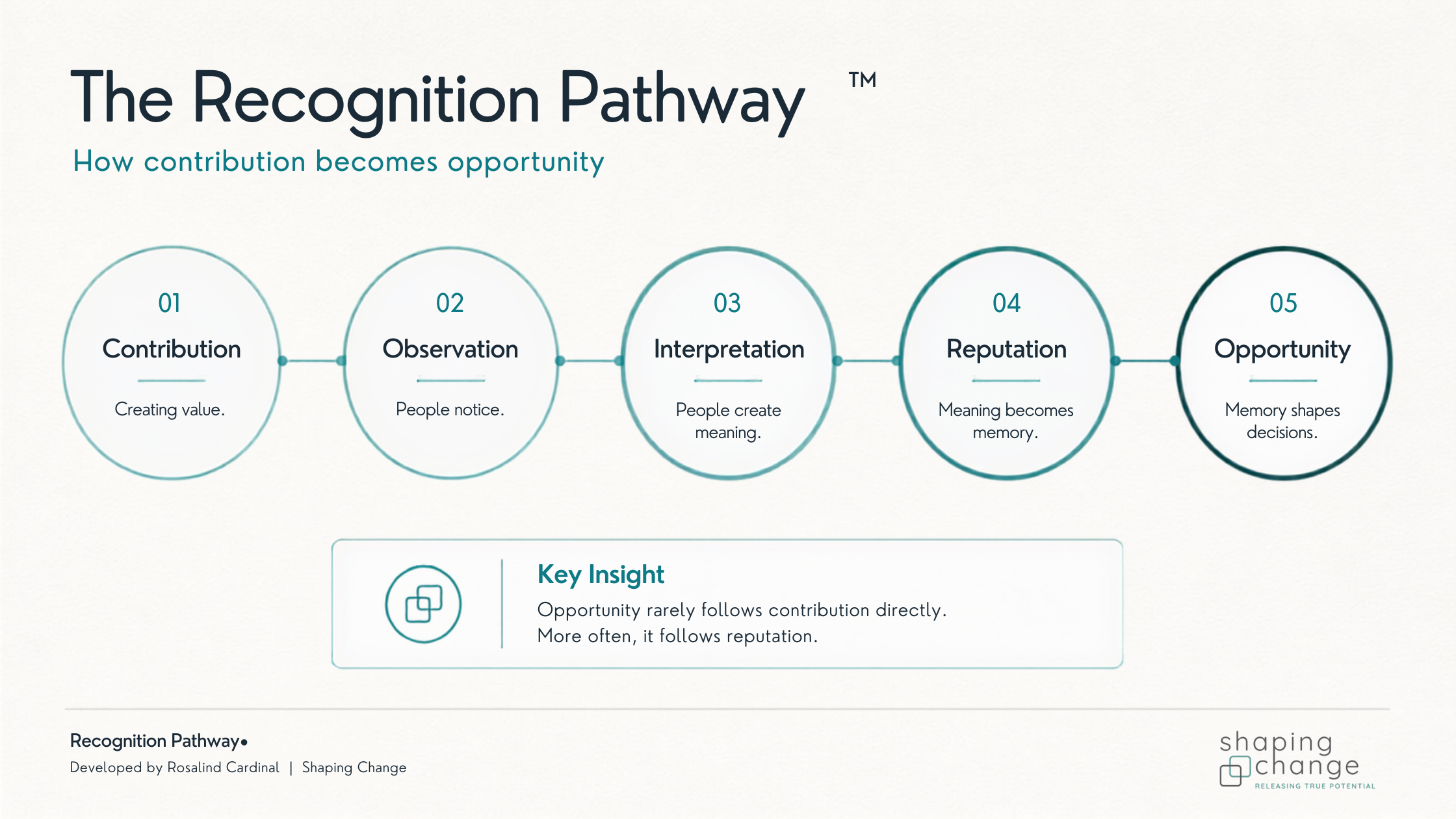
I’ve come to think of this as The Recognition Pathway™.
Rather than imagining recognition as a direct connection between hard work and opportunity, imagine it as a journey through five distinct stages. Each stage builds on the one before it. If the pathway breaks at any point, recognition struggles to move forward.
The journey always begins with contribution.
This is the work itself. Solving problems. Leading projects. Supporting colleagues. Creating value for clients. Developing new ideas. Every opportunity starts here because without contribution there is nothing to recognise.
But contribution alone isn’t enough.
Someone has to observe that contribution.
This doesn’t mean they need to witness every meeting or understand every detail. They simply need enough visibility to appreciate that something valuable has happened. This is where many capable leaders unintentionally disappear. They assume the work will speak for itself, when in reality much of the most valuable leadership work happens quietly, behind closed doors or in conversations no one else ever sees.
Observation then becomes interpretation.
People don’t simply collect facts about our work. They make meaning from what they see.
A well-managed project becomes evidence that someone is dependable. A thoughtful question in a meeting becomes evidence of strategic thinking. The calm way someone navigates conflict becomes evidence that they can lead through uncertainty.
In other words, people don’t remember every action.
They remember what those actions came to represent.
Over time, those interpretations accumulate into reputation.
Reputation isn’t something we write for ourselves. It’s the story that gradually forms in the minds of other people. It’s what colleagues mean when they say, “She’s brilliant with difficult stakeholders,” or “He’s the person who always brings clarity when things become complicated.” Those stories become surprisingly influential because they help people make decisions quickly in environments where nobody has complete information.
Finally, reputation creates opportunity.
When an important project emerges, when a promotion becomes available or when a leader asks, “Who should we involve?”, people rarely start with a blank sheet of paper. They draw upon the reputations that already exist. They think of the people whose contribution they understand and whose capability they trust.
That’s why I believe one of the hidden rules of organisational life is this:
Opportunity rarely follows contribution directly. More often, it follows reputation.
And reputation is built through the understanding people develop about our contribution over time.
Once you begin to see recognition through this lens, a great deal of organisational life starts to make more sense. It explains why exceptionally capable people can remain overlooked. It explains why someone with similar technical ability may be offered opportunities more frequently. And perhaps most importantly, it shifts the question from “Why don’t people recognise me?” to “Where is my contribution losing momentum along the pathway?”
That is a much more useful question because it moves recognition from something that feels mysterious and personal to something that can be observed, understood and intentionally strengthened.
Where Recognition Gets Stuck
Once you begin looking for the Recognition Pathway™, you start seeing it everywhere.
You notice capable people whose contribution never seems to travel beyond their immediate team. You notice others whose work is widely understood across the organisation, even though they may not be working any harder. You begin to realise that recognition isn’t simply about the quality of the work. It’s about how far that work travels.
In my experience, the pathway rarely breaks because people aren’t creating enough value. Most professionals I work with are already doing excellent work. They’re solving complex problems, supporting colleagues, leading change and delivering meaningful outcomes.
The pathway usually breaks much earlier.
It breaks because the contribution never becomes fully visible.
This is particularly true for the kinds of work that organisations depend on but rarely see.
Think about the manager who spends weeks rebuilding trust after a difficult conflict. The project lead who quietly prevents a major issue before anyone else even realises it exists. The executive who creates alignment across competing priorities, making everyone else’s work easier. Or the leader who asks the thoughtful question that changes the direction of an important decision.
These moments rarely generate applause.
They’re not announced in company newsletters.
They’re often invisible to anyone outside the immediate situation.
Yet they are some of the most valuable forms of leadership an organisation can have.
The irony is that as people become more experienced, a greater proportion of their work falls into this category. Leadership becomes less about producing tangible outputs and more about creating conditions in which other people can succeed. Influence replaces activity. Judgement replaces task completion. Sense-making replaces technical execution.
These are precisely the capabilities organisations need from senior leaders.
They’re also the capabilities that are easiest to overlook.
That doesn’t mean organisations are failing. It means organisations are human.
No leader has complete visibility of every conversation, every relationship or every decision unfolding across the business. They make sense of the organisation using fragments of information. They notice patterns. They listen to stories. They draw conclusions from what they can see.
That’s why recognition isn’t simply an individual achievement. It’s also an organisational process.
The challenge isn’t that your contribution lacks value.
The challenge is that much of its value exists in places where other people can’t easily observe it.
And when people can’t observe it, they can’t interpret it.
Without interpretation, reputation never has the opportunity to develop.
The Recognition Pathway quietly comes to a halt.
Recognising where that happens is surprisingly liberating. Instead of concluding, “I need to work harder,” or, “I need to become someone I’m not,” we can ask a much more constructive question.
What part of my contribution is still invisible to the people who need to understand it?
That question shifts our attention away from proving our worth and towards helping others see it more clearly.
It’s a subtle difference.
But it changes the conversation completely.
Visibility Isn’t Self-Promotion
For many people, the idea of becoming more visible immediately creates discomfort.
Not because they don’t want opportunities.
Not because they lack ambition.
But because visibility has become tangled up with self-promotion.
Somewhere along the way, many of us absorbed the belief that talking about our work is somehow at odds with humility. That if we allow people to see our contribution, we’re seeking attention rather than creating understanding.
I don’t believe those two things are the same.
One of the metaphors I often return to is a lighthouse.
Imagine spending months restoring a beautiful old lighthouse. You repair the foundations, polish the windows and ensure every mechanism works perfectly. Everything is ready.
Then you decide never to switch on the light.
Would anyone describe that as humility?
Of course not.
The purpose of the lighthouse isn’t to admire itself. The light exists so that other people can navigate safely. It provides clarity. It reduces uncertainty. It helps others make better decisions.
Healthy visibility serves much the same purpose.
At its best, visibility isn’t about drawing attention to ourselves. It’s about making our contribution easier for other people to understand.
That’s an important distinction because organisations are constantly making decisions with incomplete information. Leaders decide who to involve, who to trust and who to develop based on what they understand about the people around them. When our work remains invisible, they aren’t choosing to ignore us. More often, they simply don’t have enough information to connect our capability with the opportunity in front of them.
Seen through that lens, visibility becomes less about self-expression and more about service.
It helps colleagues understand where expertise exists. It helps leaders make better decisions about capability. It helps organisations connect the right people to the right opportunities.
The intention matters.
Self-promotion asks, “How can I make people notice me?”
Healthy visibility asks, “How can I help people better understand the value I bring?”
Those are very different questions.
One seeks admiration.
The other creates clarity.
One is centred on the individual.
The other improves the quality of decisions an organisation can make.
Perhaps that’s why I’ve come to see visibility as an act of leadership rather than an act of self-promotion.
Leadership has always been about reducing ambiguity. We create clarity around direction, priorities, expectations and decisions. Why should clarity about our own contribution be any different?
When we think about visibility in this way, it stops feeling performative. It becomes another way of helping the people around us make sense of a complex environment.
And that, ultimately, is what good leadership has always done.
Helping Your Contribution Travel Further
Understanding the Recognition Pathway is valuable because it gives us a different place to intervene.
If recognition were simply a matter of working harder, there would be little we could do beyond increasing our effort. But if recognition depends on how our contribution moves through observation, interpretation and reputation, then small changes in the way we communicate our work can have a surprisingly large impact.
The goal isn’t to become louder.
It’s to make the value you’re already creating easier for other people to understand.
One of the simplest ways to do that is to narrate the work while it’s happening.
Many professionals wait until a project is complete before talking about it, if they mention it at all. By then, much of the thinking, problem-solving and decision-making has already disappeared from view. Instead, consider sharing the journey as you go. A brief update in a meeting about a challenge you’re working through or a conversation about an emerging insight helps others understand not just what you’re doing, but how you’re thinking.
A second shift is to share your reasoning, not just your results.
Leadership is rarely judged solely on outcomes. People are also trying to understand how you approach complexity. Do you ask thoughtful questions? Can you simplify difficult issues? Do you anticipate risks before they become problems? When colleagues hear your thinking, they begin to recognise patterns in the way you lead. Those patterns eventually become reputation.
Finally, finish the story.
Many of us move quickly from one piece of work to the next. We deliver the project, solve the problem or support the client, and immediately turn our attention elsewhere. In doing so, we often miss the opportunity to help others understand the impact that work created.
Finishing the story isn’t about claiming credit. It’s about closing the loop.
It might be as simple as saying, “The changes we introduced last quarter have reduced customer complaints by twenty per cent,” or, “The conversations we’ve been having with the team have significantly improved collaboration.” Those moments help connect effort with impact. They allow other people to see the value that might otherwise remain hidden.
None of these practices require a different personality.
They don’t ask you to become more extroverted, more charismatic or more self-promotional.
They simply help your contribution travel further.
And that’s the important distinction.
The Recognition Pathway isn’t about manufacturing a reputation that doesn’t exist.
It’s about ensuring the reputation that develops is an accurate reflection of the value you’re already creating.
When we think about visibility in those terms, it stops feeling like performance.
It becomes an act of clarity.
A Different Question
It’s tempting to finish an article like this with a list of actions.
Speak up more often.
Share your wins.
Build your profile.
There’s nothing inherently wrong with any of those suggestions. But if we’ve understood the Recognition Pathway™, they miss the point.
The goal isn’t visibility for its own sake. The goal is understanding.
When we think about recognition this way, the conversation changes. We stop asking, “How can I get people to notice me?” and begin asking a much more useful question.
How can I help people better understand the contribution I’m already making?
It’s a subtle shift, but it changes our intent completely.
Instead of trying to create an impression, we’re creating clarity. Instead of drawing attention to ourselves, we’re reducing ambiguity about the work we do, the problems we solve and the value we create.
That’s a far more authentic way to think about visibility.
It also reflects the reality of organisational life.
Every day, leaders are making decisions based on incomplete information. They are deciding who to involve, who to trust, who to develop and who to ask for advice. Those decisions are rarely based on a complete picture of everyone’s capability. They’re based on the understanding that has developed over time through conversations, observations and experience.
The question, then, isn’t whether your work has value.
The question is whether the people making those decisions have had the opportunity to understand that value.
Seen through this lens, recognition becomes something we can influence without becoming someone we’re not.
We don’t need to manufacture a reputation.
We don’t need to become louder.
We don’t need to turn ourselves into a personal brand.
We simply need to help our contribution travel further.
Perhaps that’s the real opportunity hidden within the Recognition Pathway™.
Not to change who we are.
But to remove the unnecessary distance between the value we create and the people who could benefit from understanding it.
Because in the end, recognition isn’t about being seen. It’s about being understood.
About the Author
Ros Cardinal is the Founder and Managing Director of Shaping Change, an Australian leadership and organisational development consultancy.
With almost 40 years’ experience in organisational development, executive coaching and leadership consulting, Ros helps leaders and organisations navigate the hidden dynamics that shape culture, influence, decision-making and performance.
She is the creator of the Recognition Pathway™, Political Intelligence Compass™, Organisational Hidden Ecology™ and the Women’s Leader Archetypes™ framework.
Book a chat with Ros.
Continue Exploring
If this article has prompted you to think differently about recognition and leadership, here are a few places to continue exploring.
Shaping Change
Explore leadership development, executive coaching and organisational consulting designed to help leaders navigate complexity and build healthier organisations.
👉 https://www.shapingchange.com.au
The Archetype Effect Podcast
Many of these frameworks are explored in greater depth through The Archetype Effect, a leadership podcast created primarily for professional women navigating influence, visibility and the hidden rules of work.
👉 https://the-archetype-effect.captivate.fm/listen
Read next: If Your Organisation “Isn’t Political” Here’s What You Are Missing About Organisational Politics