
Walk into almost any organisation and you will find evidence of careful design. There are organisational charts defining reporting relationships, job descriptions clarifying responsibilities, policies establishing expectations, strategies setting direction, processes intended to create consistency and performance measures tracking results. Together, these things form the visible architecture of the organisation. They tell us where people sit, who is accountable for what, how decisions are supposed to be made and how work is intended to flow.
Yet anyone who has spent any length of time inside organisations knows that this formal architecture tells only part of the story.
Two organisations can have similar structures, comparable technology, equally capable people and almost identical strategic priorities, yet produce completely different experiences of work. One can feel energising and collaborative while another feels exhausting and political. One adapts readily to change while another appears to resist even relatively modest shifts. One can have vigorous debate and constructive disagreement; in another, meetings are polite while the real conversations happen afterwards.
If the formal structures are similar, what explains the difference?
For much of my career in organisational development, leadership development and executive coaching, that question kept resurfacing. Over time, I became increasingly interested not simply in what organisations had formally designed, but in the patterns of relationship, trust, influence, pressure and behaviour operating around that design.
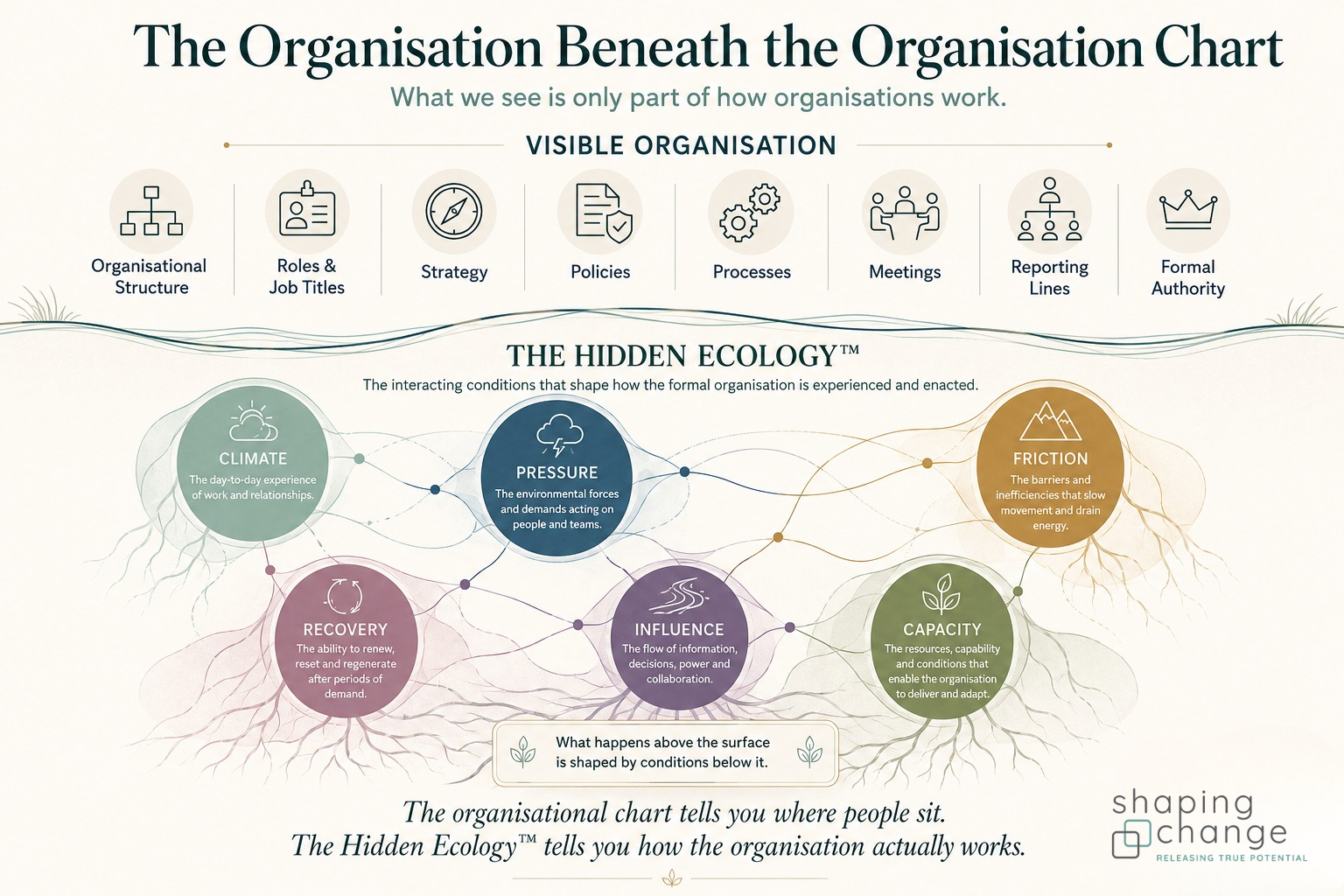
I have come to think of this as The Hidden Ecology™ of the organisation.
Just as a forest is much more than the trees we can see above the ground, an organisation is more than its visible structures. Beneath those structures sits a living network of relationships, histories, expectations, informal influence, emotional signals, accumulated pressure and learned behaviour. This ecology affects how people interpret what happens around them and, ultimately, how work actually gets done.
The organisational chart tells us where people sit. The Hidden Ecology tells us how the organisation really works.
What is the Hidden Ecology of an organisation?
The Hidden Ecology is the network of conditions, relationships, influence, history, information and patterns of behaviour that shapes how an organisation functions beneath its formal structure.
Every organisation effectively operates through two interconnected systems. The first is the visible organisation: structures, roles, policies, processes, strategy, reporting lines and formal decision rights. These elements are deliberately created and remain essential. Organisations need clarity, coordination and accountability.
The second is less formally designed but no less powerful. It is the lived system through which people experience and interpret the organisation: who trusts whom, whose opinion carries weight, what has happened before, whether people feel able to challenge, how pressure is distributed, what information moves and what gets stuck, which behaviours are rewarded, and which conversations people learn are safer not to have.
This distinction helps explain many of the apparent contradictions of organisational life. Influence does not always follow the hierarchy. Silence does not necessarily indicate agreement. Resistance may contain useful information rather than simply reflecting unwillingness to change. People may be held accountable for outcomes without having control over many of the conditions producing those outcomes. And technically sound change initiatives can fail because the system into which they are introduced is unable, unwilling or simply too depleted to absorb them.
The formal organisation matters enormously. It simply isn’t the whole organisation.
Why we have been managing organisations like machines
Much of modern management practice has been influenced by a metaphor so deeply embedded that we rarely stop to question it: the organisation as machine.
The metaphor has obvious appeal. Machines can be designed. Their component parts have defined functions. Processes can be standardised and performance measured. When something stops working, the faulty component can be diagnosed, repaired, replaced or redesigned.
This way of thinking helped organisations solve genuine problems of scale, efficiency and coordination, particularly as organisations became larger and more complex. Many of the practices that emerged from it remain indispensable. Clear roles are useful. Well-designed processes matter. Good governance matters. Formal accountability matters.
The problem begins when we mistake the architecture for the organisation itself.
People do not behave like mechanical components. They interpret events through previous experience. They form loyalties and relationships and make judgments about who can be trusted. They notice what happens when somebody challenges a senior person. They work out whose support is needed before an idea reaches the formal decision-making table. They remember promises that were made during the last restructure and whether those promises were kept.
They also learn from what the organisation repeatedly does, not simply from what it says.
An organisation may formally encourage people to speak up, for example, while its people simultaneously observe that those who raise uncomfortable issues are labelled difficult. It may describe innovation as a strategic priority while responding harshly to visible failure. It may promote collaboration while rewarding functions primarily for protecting their own targets.
Over time, these experiences accumulate. People adapt to the conditions around them, and those adaptations become patterns. Eventually those patterns begin to look like culture.
This is why two organisations with almost identical formal structures can behave completely differently. The visible architecture may be similar. The ecology surrounding it is not.
Organisations are living systems
The idea that organisations should be understood as interconnected systems rather than collections of isolated components has a long intellectual history. Systems thinkers have repeatedly challenged the tendency to understand complex problems by breaking them into isolated components without examining the relationships between them.
Peter Senge brought this perspective directly into organisational thinking, emphasising patterns, relationships and interconnectedness across the wider system. Donella Meadows went further into the question of intervention, showing that changing a system often depends on finding the right leverage point rather than acting on its most visible symptoms. The Hidden Ecology™ sits within this intellectual tradition, while applying the lens specifically to the conditions through which people experience and enact organisational life.
Its purpose is highly practical. It asks a deceptively simple question:
What does a leader need to notice in order to understand why this organisation is producing these particular patterns of behaviour?
The ecology metaphor becomes especially useful here.
Imagine standing beside a river. From the bank, the surface may appear calm, yet beneath it currents are interacting with rocks, temperature, depth, vegetation, debris and the contours of the riverbed. What we see at the surface is real, but it cannot be completely understood without knowing something about the conditions underneath it.
Organisations operate in much the same way.
A conversation before a meeting can change the trajectory of a decision before the agenda item is even reached. A failed restructure several years earlier can shape reactions to today’s change announcement. A highly trusted frontline employee can influence the response of an entire work group despite holding no formal leadership position. A leader who consistently invites challenge and responds constructively when challenged can gradually alter what people believe is safe to say.
Likewise, a team may appear resistant when it is actually exhausted. A manager may appear unable to improve engagement having inherited structural and organisational conditions over which they have limited influence. A department may appear unwilling to collaborate when years of competition for resources have made protective behaviour entirely rational.
These are not mysterious forces. They are patterns generated by the interaction between people and their environment.
Learning to read those patterns changes the quality of organisational diagnosis.
Culture is an outcome of repeated experience
Organisational culture is sometimes treated as if it were a discrete thing an organisation possesses: something that can be articulated through a values statement, measured through a survey and then deliberately shifted through a culture program.
There is value in all of those activities, but they can also encourage us to underestimate how culture actually develops.
Culture is built through repeated experience.
People notice what happens when someone makes a mistake. They notice how leaders behave when performance falls short, whether bad news travels upwards safely, whether disagreement is interpreted as contribution or disloyalty, and whose behaviour appears exempt from the standards expected of everyone else.
They notice whether important decisions arrive as surprises. They notice whether workloads are routinely allowed to become unreasonable. They notice which issues are discussed repeatedly without ever being resolved. They notice what the organisation does when commercial or operational pressure conflicts with its stated values.
Each experience provides information about how the system works. Gradually, people develop expectations about what will happen next. Those expectations shape choices, and when enough people make similar adaptations to the same conditions, recognisable cultural patterns emerge.
This is why changing the language of culture is relatively easy while changing the lived experience of culture is considerably harder.
People respond not only to what an organisation says it values, but to what their accumulated experience tells them the organisation actually rewards, permits, notices and protects.
Six lenses for reading the Hidden Ecology
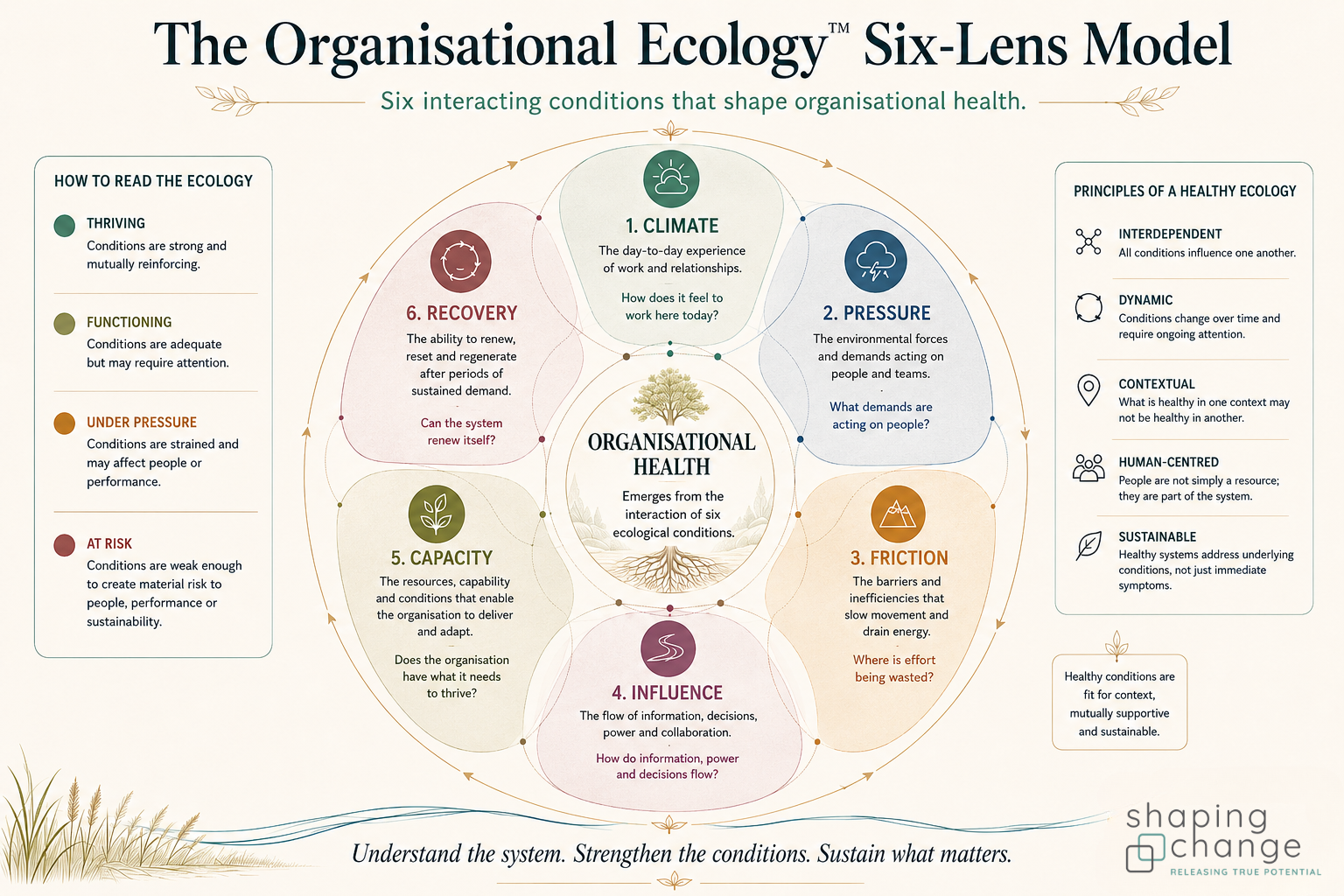
As the Hidden Ecology framework has developed, I have found six lenses particularly useful for examining the conditions beneath visible organisational outcomes: Climate, Pressure, Friction, Influence, Capacity and Recovery.
They are not six independent variables, nor are they intended to function as a psychometric assessment. They are diagnostic lenses: different ways of interrogating a living system and looking for relationships that a conventional organisational chart or dashboard may not reveal.
Organisational health emerges from the interaction between these conditions. That does not mean every organisation should somehow achieve an equal “balance” across all six. Different contexts create different demands. What matters is whether the conditions are fit for context, mutually supportive and sustainable.
Climate
Climate describes the experienced atmosphere surrounding the work. It includes the subtle and explicit signals people receive about what is safe, expected or risky.
Can people disagree with someone more powerful? What happens when bad news is raised? Are questions interpreted as curiosity or criticism? Can people admit they do not know something? What happens after someone makes an error?
These experiences create an emotional context within which work takes place. A team working in a climate of trust and candour will behave very differently from an equally capable team operating in a climate of caution, even if their formal responsibilities are identical.
Pressure
Pressure is unavoidable in organisational life and is not inherently damaging. Deadlines, ambitious goals, accountability and demanding work can create energy, focus and performance.
What matters is what the pressure is causing the system to do.
Under sustained, excessive or conflicting pressure, behaviours can shift. People may become more cautious, territorial, short-term in their thinking or less willing to invest time in collaboration. Teams may begin working around rather than through formal processes. Leaders may unintentionally transmit their own pressure downwards. Immediate delivery can begin competing with learning, quality and longer-term capability.
When we diagnose behaviour without understanding the pressure surrounding it, we risk treating an adaptation as though it were a character flaw.
Friction
Friction occurs where organisational energy is repeatedly being lost.
Sometimes that friction is relational: two functions no longer trust one another. Sometimes it is structural: decision rights are unclear or responsibilities overlap. Sometimes it sits between processes, priorities or systems that make sense individually but interact badly in practice.
Persistent friction is particularly interesting because it often reveals a gap between the organisation as designed and the organisation as experienced.
If people are constantly creating workarounds, escalating the same issues or relying on particular individuals to navigate a broken interface, those patterns provide useful diagnostic information. They tell us where the ecology and formal architecture may no longer be aligned.
Influence
Formal authority tells us who is entitled to make a decision. Influence tells us who can shape what happens around it.
Every organisation contains informal networks of credibility, access and relationship. Some people become trusted interpreters of events. Others act as connectors between groups. Some have the ear of senior decision-makers. Others carry significant credibility because of their expertise, history or standing with colleagues.
Understanding these networks does not mean encouraging manipulation or dysfunctional politics. It means acknowledging an organisational reality: influence does not distribute itself neatly according to position titles.
This becomes especially important where responsibility and influence are misaligned. A leader can be held accountable for an outcome while lacking sufficient authority or influence over many of the conditions producing it. Conversely, individuals can exercise substantial informal influence without carrying equivalent formal accountability.
Those asymmetries matter.
Capacity
Organisations do not have infinite capacity to absorb change, even when the proposed change is sensible.
A workforce carrying vacancies, a major technology implementation, several concurrent restructures and a demanding operational environment may sincerely support another worthwhile initiative and still be unable to implement it successfully.
Capacity includes more than hours available in the working week. It can also include cognitive capacity, emotional bandwidth, leadership attention, skills, resources and the organisation’s ability to make sense of multiple competing demands.
This means apparent resistance is sometimes better understood as saturation.
The question is not always, “Do people support this?”
Sometimes it is, “Does the system currently have sufficient capacity to absorb it?”
Recovery
Living systems need opportunities to recover.
Periods of intense effort are sometimes unavoidable. Problems arise when the organisation treats exceptional effort as a permanent operating model and moves immediately from one period of sustained pressure into the next.
Recovery includes the system’s ability to restore depleted capacity, repair relationships, learn from experience and make sense of what has occurred. It asks what happens after a difficult project, major change, conflict, failure or prolonged period of demand.
Does the organisation stop long enough to learn? Are damaged relationships repaired? Do leaders recognise accumulated fatigue? Does the system regain capacity before another major demand arrives?
Without recovery, an organisation can gradually consume the very cultural strengths that once made it successful.
The most important feature of these six lenses is that they do not operate independently. Pressure influences climate. Friction consumes capacity. Climate affects information flow and people’s willingness to exercise influence. Low capacity makes recovery more difficult, while inadequate recovery increases vulnerability to the next period of pressure.
The ecology behaves as a system.
That interaction is precisely why isolated organisational solutions can be so disappointing.
Engagement data is a signal, not a diagnosis
One of the most important developments in our thinking about the Hidden Ecology has been recognising the distinction between data and diagnosis.
Organisations now have access to enormous amounts of people data: engagement surveys, pulse surveys, culture assessments, exit data, performance indicators, psychosocial risk information, customer measures and increasingly sophisticated analytics.
All of this can provide useful evidence.
But the result itself does not tell us why it occurred.
Imagine, for example, that one part of an organisation records lower engagement results than the others. It is tempting to move immediately into action planning, particularly if leaders feel pressure to demonstrate that something is being done.
Yet there may be many plausible explanations. Leadership behaviour may indeed be contributing. But that area may also be under significantly greater operational pressure. It may have recently experienced disruption or organisational change. It may work with especially demanding clients or customers. There may be unresolved conflict, resource shortages or long-standing frustration with decisions made elsewhere in the organisation.
It is even possible that a lower result reflects greater psychological safety: people may simply feel more comfortable giving candid answers.
Several explanations can be true simultaneously.
A survey score therefore tells us where we might need to look. It does not automatically tell us what we will find when we get there.
The Hidden Ecology encourages a more disciplined diagnostic sequence:
Data → Pattern → Hypothesis → Triangulation → Validated Diagnosis → Intervention
The first task is to notice the signal and examine the pattern around it. From there, we can develop plausible hypotheses about the conditions producing what we see and test those hypotheses against other evidence and perspectives. Only when the diagnosis becomes sufficiently robust should we decide where intervention is likely to have leverage.
At first glance, this can appear slower than moving immediately into action planning.
In practice, it may save enormous amounts of wasted organisational effort.
The problem with accountability without authority
An ecological perspective also reveals an uncomfortable feature of many organisational systems: people are frequently held accountable for outcomes they can influence but cannot fully control.
Employee engagement is a good example.
The immediate leader undoubtedly matters. Leadership behaviour has an important effect on people’s experience of work and should not be ignored.
But the same employee is also experiencing executive decisions, organisational strategy, remuneration, technology, workload, restructures, career opportunities, policies and events occurring far beyond the authority of their direct manager.
Handing a manager an engagement score and effectively saying, “This is your result; now fix it,” can therefore confuse accountability with control.
A more intelligent diagnosis asks several questions. What can this leader directly change? What can they reasonably influence? Which conditions require action elsewhere? Where does authority actually sit? And are we asking somebody to take responsibility for an outcome without giving them access to the leverage points capable of changing it?
That does not remove accountability.
It creates more precise accountability.
It also helps organisations stop repeatedly attempting to solve systemic issues at the wrong level of the system.
Why good change initiatives can still fail
Every year, organisations invest substantial resources in improving performance and culture. They restructure teams, introduce technology, refresh values, redesign processes, launch strategies and invest in leadership development.
Many of these initiatives are thoughtful, evidence-informed and well executed.
Yet the familiar pattern persists. Initial enthusiasm is followed by substantial activity, momentum gradually fades and, months later, many of the behaviours the initiative was intended to address remain firmly in place.
We often explain this by saying people resisted the change.
Sometimes they did.
But an ecological perspective suggests another possibility: the existing system continued to reproduce the conditions that made the old behaviour rational.
Introduce a leadership program into an environment in which challenging authority has historically carried consequences and a workshop will not instantly create candour. Ask two functions with a long history of competition to collaborate and a new process will not immediately repair their relationship. Tell people to experiment while continuing to punish visible failure and they will pay considerably more attention to the consequences they observe than the innovation language they hear.
The intervention may be new.
The ecology surrounding it is not.
This is why the same organisational intervention can generate very different results in different environments. The question is not only whether the intervention itself is sound. We also need to ask what happens when it meets the existing system.
Stop trying to fix people before understanding the conditions
One of the most consequential shifts created by ecological thinking is that it changes where we begin our diagnosis.
When something is not working, organisations have a natural tendency to locate the problem in an individual.
Who needs more capability? Who isn’t performing? Who is resisting? Who needs coaching? Who needs to be held accountable?
Sometimes the answer genuinely does sit with an individual, and systemic thinking should never become an excuse for avoiding personal accountability.
But starting with the individual can lead us to mistake symptoms for causes.
If a team avoids difficult conversations, perhaps its people do need greater confidence and skill. Alternatively, they may have learned through experience that candour carries a cost.
If innovation is declining, employees may need techniques for creative thinking. Or they may have watched every failed experiment receive intense scrutiny while successful risk-taking attracts little recognition.
If people appear exhausted, individual resilience practices may provide some benefit. But no amount of resilience training can compensate indefinitely for unreasonable workload, chronic ambiguity, poor systems and uninterrupted organisational change.
The ecological question is therefore not simply, “What is wrong with these people?”
It is:
What combination of individual behaviour and system conditions is producing what we are seeing?
That question still leaves room for individual responsibility. It simply refuses to pretend that human behaviour occurs independently of context.
From action planning to system action
This brings us to another common organisational habit: moving from insight to action too quickly.
A survey is presented. Groups discuss the findings. Workshops generate lists of ideas. Actions are assigned to owners and entered into plans. Everyone leaves with the reassuring sense that something is happening.
Six months later, the organisation may discover that there has been a great deal of activity but surprisingly little systemic change.
The Hidden Ecology invites us to distinguish between action and system action.
Some conditions need to be protected. An organisation with strong trust, high commitment or valuable cultural practices can inadvertently damage those strengths while pursuing improvement. Understanding what is driving positive results is therefore just as important as investigating what is going wrong.
Other conditions need to be repaired. Damaged trust, unresolved history, poor information flows or fractured relationships may require deliberate intervention before new behaviours can take hold.
And some conditions need to be redesigned. If the real problem sits in decision rights, workload, incentives, resource allocation, operating processes or organisational structure, goodwill and coaching will only take us so far.
Protect. Repair. Redesign.
These represent fundamentally different responses to organisational diagnosis.
There is also a final question that organisations frequently overlook:
Who has the authority to act?
A team can identify a systemic problem perfectly and still be incapable of solving it if the leverage point sits elsewhere. Asking people repeatedly to take action on issues over which they have little authority is not empowering. Eventually, it becomes another source of frustration.
Good system action therefore connects three things: the condition creating the pattern, the intervention capable of influencing that condition and the level of authority necessary to make the intervention possible.
Becoming an organisational ecologist
For much of my career, I thought my role was to help organisations solve problems. Over time, I became more interested in what the organisation was trying to tell me.
A recurring conflict is information. A stalled project is information. Silence in a meeting is information. So is the decision everybody privately disagrees with but nobody challenges. A highly engaged team in an otherwise struggling organisation is information too.
The organisational ecologist learns to treat these patterns as clues.
Where does information move naturally, and where does it stop? Who is trusted? Where is energy being lost? What happens when the organisation comes under pressure? Which relationships allow people to work around weaknesses in the formal structure? Where does responsibility exceed authority? What has the organisation learned from its own history? Which strengths are more fragile than they appear? What is everybody talking about outside the room that remains difficult to discuss inside it?
And perhaps one of the most useful questions is:
What would have to be true about this system for the behaviour we are seeing to make sense?
That question does something important.
It moves us away from premature judgment and towards curiosity.
And curiosity makes better diagnosis possible.
Learning to see the organisation beneath the organisation chart
The Hidden Ecology is not another culture program or organisational structure. Nor are its six lenses intended to provide a simplistic formula for explaining every organisational problem.
It is a way of seeing, investigating and ultimately working with organisational systems.
It asks us to notice both the visible organisation and the lived system operating around it. To distinguish evidence from interpretation. To understand conditions before prescribing interventions. To recognise informal influence without assuming that organisational politics is inherently dysfunctional. To examine where responsibility and authority have become disconnected. And to recognise that sometimes the most important intervention is not to change what exists, but to understand and protect what is already working.
Those shifts change the questions leaders ask.
Instead of immediately asking why people are resisting a change, we can ask what the system might be telling us through their response.
Instead of asking how to improve an engagement score, we can investigate which conditions are producing the experiences reflected in the data.
Instead of telling people they need to collaborate more effectively, we can ask what currently makes collaboration difficult.
And instead of creating another action plan, we can ask what needs to be protected, repaired or redesigned, where the real leverage sits and who has the authority to act.
Organisations will always need structures, processes, strategies and measures. Ecological thinking does not replace any of them.
It simply reminds us that the organisation is also a living human system.
And once we learn to see the relationships, pressures, histories, patterns and conditions beneath the formal structure, things that once seemed irrational often become far easier to understand.
The organisational chart will always tell us where people sit.
The Hidden Ecology tells us how the organisation comes alive.
Intellectual foundations and further reading
The Hidden Ecology™ sits within a broader tradition of systems thinking that has challenged the tendency to understand organisations by examining their component parts in isolation.
Peter Senge’s The Fifth Discipline helped bring systems thinking into mainstream organisational practice, particularly through its emphasis on seeing patterns, relationships and interdependencies across a wider system rather than reacting only to isolated events.
Donella Meadows’ work provides another important foundation. In Leverage Points: Places to Intervene in a System, Meadows explored why some places within a system offer substantially greater leverage than others. Her work on information flows, rules, power and underlying assumptions is particularly relevant to the Hidden Ecology emphasis on diagnosing the conditions producing a pattern before deciding where to intervene.
For readers wanting to explore this tradition further:
Peter M. Senge — The Fifth Discipline
Donella H. Meadows — Thinking in Systems: A Primer
Donella H. Meadows — Leverage Points: Places to Intervene in a System
About Ros
Rosalind Cardinal is the Founder and Managing Director of Shaping Change, an Australian leadership and organisational development consultancy.
With almost 40 years’ experience in organisational development, executive coaching and leadership consulting, Ros helps leaders and organisations navigate the hidden dynamics that shape culture, influence, decision-making and performance.
She is the creator of the Recognition Pathway™, Political Intelligence Compass™, Organisational Hidden Ecology™ and the Women’s Leader Archetypes™ framework.
Book a chat with Ros.
Read Next: Leadership in Turbulent Times: Why Control No Longer Works