
Organisational culture is easy to talk about when everything is going well. Values sound compelling on a website. Leaders can speak convincingly about trust, collaboration, innovation and accountability. Culture statements can be carefully crafted, launched and displayed around the workplace.
The real test comes when those values become inconvenient. What happens when a high-performing executive behaves in a way that conflicts with the culture you say you want? What happens when schedule pressure begins competing with safety? What happens when someone challenges the prevailing view, or when an experiment fails?
Those are the moments when organisational culture stops being an aspiration and becomes visible.
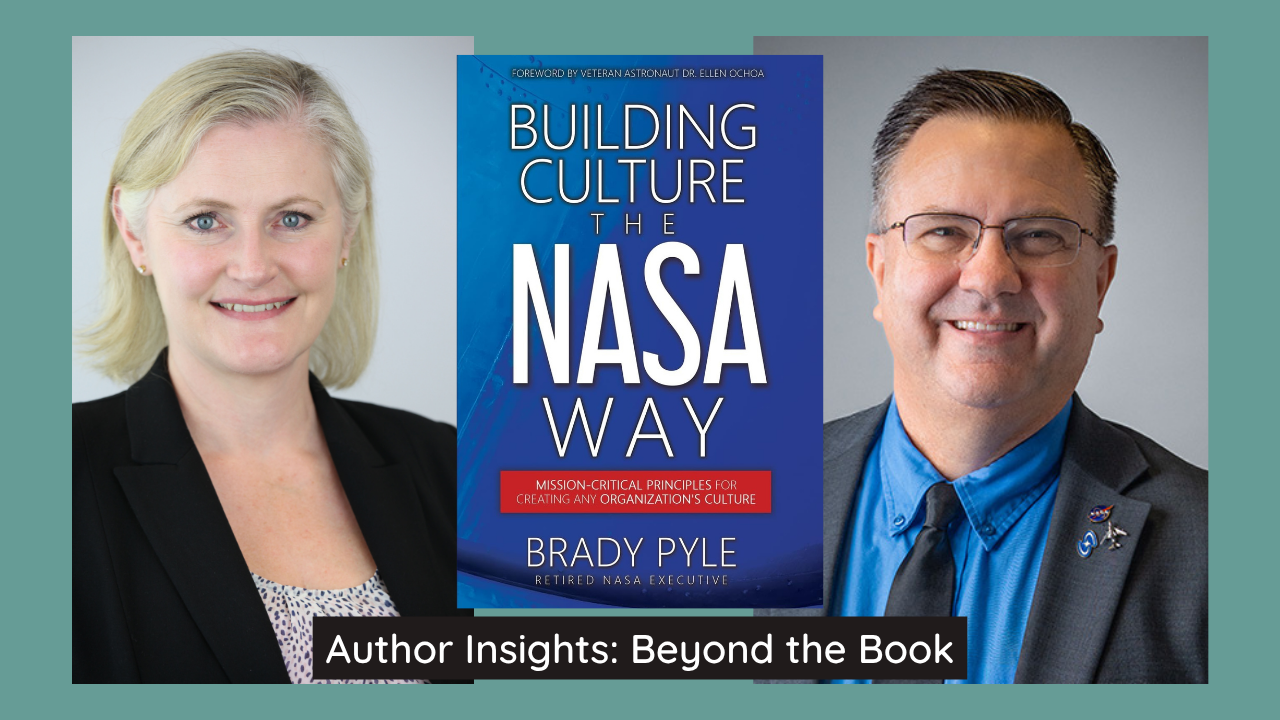
I recently spoke with Brady Pyle, author of Building Culture the NASA Way, for my Beyond the Book series. Brady spent 30 years at NASA, advising, leading and coaching engineers, rocket scientists, astronauts and senior executives. He later became NASA’s first leader of HR field executives and today serves as Chief Human Resources and Inclusion Officer at Space Center Houston.
Our conversation reinforced something I have seen repeatedly in my own culture work: culture is not primarily created through what organisations say. It is created through the systems they build, the behaviour they reward and the choices leaders make when the choice is difficult.
Culture can be designed — but people aren’t machinery
Brady describes culture as an engineering challenge involving human systems. At NASA, that language mattered because in an organisation dominated by scientists and engineers, describing culture as something systematic helped move it away from being dismissed as the “soft people stuff”. Culture could be examined, measured and intentionally influenced through processes, structures and leadership behaviour.
There is an important qualification, of course. People are not spacecraft. Human beings interpret events, remember what has happened, tell stories, form informal networks and respond differently to the same leadership behaviour. They sometimes ignore the process entirely.
So building organisational culture is not engineering in the sense that leaders can simply design the perfect system and predict the result. But leaders can deliberately create conditions that make some behaviours more likely than others. They can design how decisions are made, determine who has access to information, decide whether dissent is genuinely welcomed, build systems of accountability, create alternative career paths and influence who gets promoted, what gets rewarded and what gets tolerated.
People notice all of it.
A strong culture is not necessarily a healthy culture
NASA presents a fascinating case because it has many of the characteristics leaders normally want to create. It has an extraordinarily powerful mission, people can feel deeply connected to the purpose of the organisation, and employees are surrounded by talented colleagues working on difficult and meaningful problems.
Yet a compelling mission does not automatically create a healthy culture.
The Columbia accident exposed significant organisational issues, including communication failures, the normalisation of risk and concerns that were unable to travel effectively through the hierarchy. Brady described NASA at the time as having become insular, with a sense of, “We’re NASA. We know how to do this.”
That confidence had consequences. When an organisation becomes convinced that its past success proves the superiority of its current thinking, learning becomes harder. External ideas are easier to dismiss, challenging the prevailing view becomes more difficult, and practices that once served the organisation can continue long after conditions have changed.
It is an important distinction. A culture can be strong because people share the same beliefs and behave consistently, but that does not necessarily make those beliefs useful. Sometimes the strength of a culture is precisely what makes it dangerous.
Culture becomes real when leaders have something to lose
One story Brady shared from Space Center Houston illustrates this particularly well.
The organisation had deliberately identified alignment, collaboration and trust as important elements of the culture it wanted to build. A senior executive was highly effective in many respects. He delivered results, his own team regarded him as a strong leader, and he possessed a relatively unusual combination of skills that made him difficult to replace.
Yet his behaviour within the executive team conflicted with the culture the organisation was trying to create. Ultimately, the CEO made the decision to let him go.
That is where values become real.
It is relatively easy to insist on cultural standards when addressing a struggling employee several layers down the organisation. It is considerably harder when the person is senior, successful, respected by their team and difficult to replace. But organisations teach people what their values really mean through exactly these moments.
Had the behaviour been overlooked because the executive delivered results, employees could reasonably have concluded that results were the real value and collaboration was merely something written on the wall.
Every organisation has moments like this, although they are not always as dramatic. The question is not simply, “What are our values?” A more revealing question is, “What happens here when living our values becomes costly?”
Your culture has a memory
One of the most interesting parts of our conversation concerned organisational stories.
At Space Center Houston, Brady discovered a lingering scarcity mentality that made complete sense when viewed through the organisation’s history. In its early years, the organisation had experienced significant financial pressure.
Years later, financial conditions had changed substantially. The organisation had diversified its revenue and had considerably greater capacity to invest. But parts of the old culture remained.
People who had lived through the lean years understandably carried some of that experience with them. Behaviour that had once protected the organisation could now inhibit investment and growth.
I see this frequently in culture work. An employee tells me, for example, that people are frightened to speak up because somebody once suffered consequences for challenging a decision. I ask when it happened. Sometimes nobody knows. Other times, someone eventually explains that it happened 15, 20 or even 30 years ago.
The people involved may have left, the leader may have left, and the policies may have changed, but the story survived.
Organisations have long memories, and cultural folklore can sometimes outlive the conditions that created it. Leaders therefore need to understand not just what people believe, but why they believe it. Which organisational experiences created that belief? Is the belief still accurate? And if it is no longer accurate, what new experiences will demonstrate that something has genuinely changed?
You rarely replace an old cultural story by announcing a new one. You replace it by giving people evidence.
People watch what happens after failure
NASA encountered exactly this problem around innovation.
A cultural message had developed that when prominent projects failed, their leaders could find themselves moved into less significant or less visible roles. Whether or not every case followed that pattern was almost beside the point. People were watching, and the organisational story became: failure damages your career.
That creates a problem if the organisation simultaneously wants people to experiment, innovate and push technological boundaries.
NASA began deliberately changing that story. Brady described a project leader whose highly visible project failed while pushing the limits of new technology. Instead of quietly sidelining him, NASA later placed him on an even more visible project.
People noticed that too.
It demonstrated something no slogan about innovation could have achieved. Failure had genuinely become something the organisation could learn from rather than automatically punish.
This is one of the fundamental mechanisms of culture. People pay attention to what happens to other people. Who gets promoted? Who disappears? Who gets invited into important conversations? Who receives another opportunity after making a mistake? Whose behaviour is tolerated because they get results?
The answers create the unofficial employee handbook.
Years ago, I worked in an organisation where people who had fallen out of favour would sometimes be moved into a relatively obscure project area. It may have appeared discreet from the perspective of senior management, but employees had another name for it. They called it “the departure lounge.”
Everyone knew what it meant.
Never assume that people do not see the patterns. They do.
Engagement data can tell you where to look. It cannot tell you everything.
NASA made extensive use of employee engagement data as its culture work developed, and Brady remains a strong advocate for measurement. So am I.
Good culture diagnostics can reveal patterns that anecdote alone will never expose. But one of the most important points in our conversation was that a survey is still only one source of evidence.
Engagement data gives you shapes and patterns. It helps identify where something deserves attention, but then the real investigation begins. You talk to people, run focus groups, conduct listening tours, speak with frontline employees, ask leaders what they are observing and explore the history behind the result.
Anyone who has facilitated employee focus groups will recognise the moment when someone approaches during the break and says, “I didn’t want to put this in the survey, but I need to tell you something.”
Those conversations matter because quantitative and qualitative data do not always tell the same story. A survey might identify an issue, but a conversation helps explain why the issue exists.
This is becoming particularly important as artificial intelligence becomes better at interrogating large employee datasets. AI may become extremely useful for detecting patterns, comparing themes and helping leaders navigate complex information, but there is a significant risk if leaders begin believing that analysing the data removes the need to talk to the humans who produced it.
It does not. AI can help you see the pattern, but it cannot automatically understand the lived organisational context behind the pattern.
Psychological safety needs pathways, not just open doors
Many leaders will tell employees, “My door is always open.” The problem is that technically having an open door does not guarantee that difficult information will travel through it.
After Columbia, NASA introduced additional mechanisms designed to help technical and safety concerns move through the organisation. Brady described changes including an ombuds process, clearer separation between some technical and program responsibilities, and pathways for dissenting technical opinions.
This matters because speaking up is not simply an individual courage problem. It is a system problem.
If the only pathway for raising a concern requires someone to challenge their own manager, potentially damage an important relationship and trust that the manager will then escalate the issue, the organisation has created a fragile information system.
Healthy cultures create multiple routes for inconvenient information to travel. They also pay attention to what happens after somebody uses them.
People very quickly learn whether raising a concern leads to curiosity, investigation and thoughtful consideration, or defensiveness, marginalisation and reputational risk. Again, culture is being created by what happens next.
Leadership should be treated as a discipline
Another particularly valuable lesson from NASA concerns career progression.
Technical organisations frequently take outstanding specialists and promote them into management because leadership is the only available route to greater status, salary or responsibility. The problem is obvious. Being an exceptional engineer does not necessarily mean someone wants to lead people, nor does it mean that removing them from technical work is the best use of their capability.
NASA developed parallel career pathways that allowed technical specialists to progress to senior levels without requiring them to become people managers. At the same time, people leadership itself began to receive greater emphasis.
Brady described a shift in the weighting given to leadership compared with technical results when executives were evaluated. The message was simple but significant: how you achieve results matters.
Leadership is not something automatically bestowed when somebody becomes senior enough. It is a professional discipline requiring its own capabilities, and sometimes the transition from expert to leader involves a profound change in identity.
The person who spent years being rewarded for knowing the answer may now need to become the person who asks the questions that help others develop the answer.
Stop trying to fix everything
Culture problems can feel enormous. Once leaders begin looking closely, they may discover issues involving trust, communication, leadership capability, workload, decision-making, silos, career development, recognition and accountability.
The natural response is often to create an equally enormous culture transformation program.
Brady offered a much simpler starting point: remove the irritants.
Ask people what makes it unnecessarily difficult for them to do good work, then fix something that matters.
There is considerable wisdom in that approach. Employees are understandably sceptical when leaders ask for feedback repeatedly but nothing visibly changes. A relatively small improvement can have disproportionate cultural value when it demonstrates, “We heard you. We took you seriously. And something happened.”
That begins creating credibility for the larger work.
NASA used a similar philosophy by identifying a small number of critical areas for improvement rather than trying to transform everything simultaneously. Culture change does not require ignoring complexity. It requires finding the points where intervention creates the greatest leverage.
Culture is the accumulation of evidence
Perhaps that is the central lesson from NASA.
Organisational culture is not created by one big initiative. It accumulates through what people experience over time.
A leader challenges an uncomfortable idea. A technical concern gets heard. A failed experiment becomes a learning opportunity rather than a career-ending event. A high performer is held to the same behavioural expectations as everyone else. A specialist is allowed to build an exceptional career without being forced into people management. An employee says, “This process drives us mad,” and somebody actually fixes it.
Each of those experiences gives people another piece of evidence about how the organisation really works. Over time, those experiences become stories, the stories become expectations and the expectations become culture.
That is why building organisational culture is ultimately less about finding the perfect set of values and more about making deliberate choices, again and again, about the organisation you are trying to create.
Because people are always watching what happens next.
Watch the conversation
My conversation with Brady Pyle, author of Building Culture the NASA Way, explores these ideas in much greater depth, including what NASA learned from Challenger and Columbia, how organisations can preserve institutional knowledge, why informal conversations matter to organisational safety, how NASA approached leadership development, and why leaders should focus on a critical few culture improvements.
Watch the full Beyond the Book interview on YouTube
Find Brady Pyle’s book, Building Culture the NASA Way
About Ros
Rosalind Cardinal is the Founder and Managing Director of Shaping Change, an Australian leadership and organisational development consultancy.
With almost 40 years’ experience in organisational development, executive coaching and leadership consulting, Ros helps leaders and organisations navigate the hidden dynamics that shape culture, influence, decision-making and performance.
She is the creator of the Recognition Pathway™, Political Intelligence Compass™, Organisational Hidden Ecology™ and the Women’s Leader Archetypes™ framework.
Book a chat with Ros.
Read Next: AI Risk and Organisational Culture: What the AI Race Teaches Leaders About Hidden Ecology