
Artificial intelligence is making it easier than ever to produce answers, reports, strategies and decisions. Can AI co-thinking help us think better?
As organisations race to adopt generative AI, much of the conversation focuses on productivity. How many hours can we save? Which tasks can we automate? How much faster can we produce the work? These are reasonable questions, but they overlook something fundamental. What happens when AI accelerates the work without improving the thinking behind it?
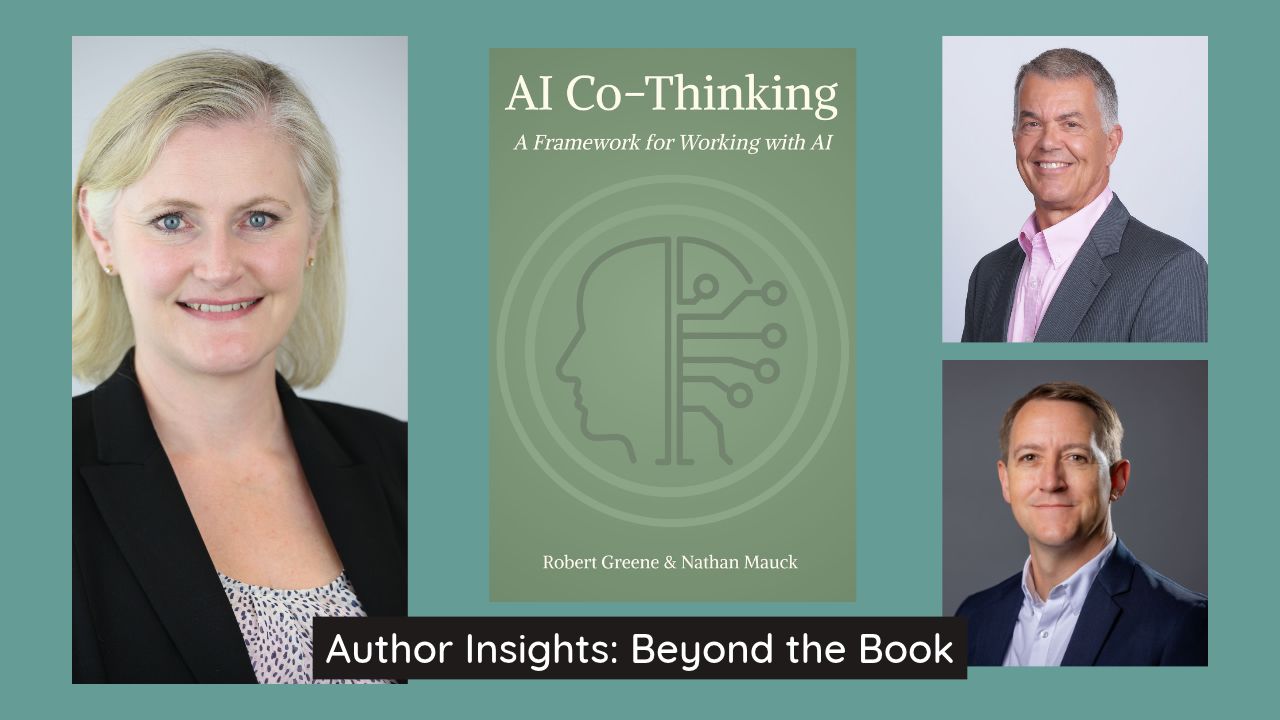
I recently explored this question with Robert Greene and Nathan Mauck, co-authors of AI Co-Thinking: A Framework for Working with AI, in a Beyond the Book interview. Their central argument is deceptively simple: the greatest opportunity presented by artificial intelligence may not be replacing human thinking, but strengthening it.
It’s a proposition that resonates strongly with my work in organisational development and leadership. For decades, we’ve been helping leaders develop their judgment, challenge assumptions and make better decisions. Now we have a technology that could potentially accelerate that development, provided we approach it thoughtfully. Equally, we have a technology that could allow people to bypass those very capabilities.
The difference lies in how we choose to use it.
What Is AI Co-Thinking?
AI co-thinking is an approach to working with generative artificial intelligence that positions the human as the leader of the thinking process. Rather than treating AI as a tool that simply produces answers, it becomes an interactive thinking partner. You bring the context, expertise, questions and judgment, while AI helps examine assumptions, consider alternative perspectives, identify gaps and refine your reasoning.
The difference matters because when we use AI primarily to generate output, we’re often asking it to execute a task we’ve already defined. When we use AI for co-thinking, we’re willing to examine whether we’ve defined the right task in the first place.
Robert and Nathan argue that successful AI adoption depends on combining the capabilities of artificial intelligence with disciplined human intelligence. In practical terms, that means starting with the problem we’re trying to solve rather than the technology we’re excited to use. Sometimes, the most valuable outcome isn’t a faster answer. It’s discovering that we’ve been asking the wrong question.
The Hidden Risk: When AI Makes Bad Thinking Look Good
One of the most important challenges we discussed is AI’s ability to produce convincing responses to poorly framed questions. Generative AI can take incomplete information, flawed assumptions or an unclear problem definition and produce an answer that sounds sophisticated. The formatting is professional, the language is confident and the reasoning may appear logical, but none of that guarantees the answer is correct, relevant or useful.
In fact, the fluency of AI-generated output can make poor reasoning harder to recognise.
Imagine a management team developing a new business strategy. They ask AI to evaluate several options, produce a market analysis and recommend a preferred approach. The output looks impressive, but what if the original options were based on incorrect assumptions? What if critical stakeholder perspectives were missing, or the team had misunderstood the underlying problem? AI might produce a beautifully structured recommendation that reinforces the very weaknesses the organisation needed to challenge.
AI can help us think more effectively, but it can also help us become more convincing in our mistakes.
This is why critical thinking becomes more important, not less, as AI capabilities improve. The ability to question an answer, recognise gaps in reasoning and evaluate evidence is what allows us to distinguish genuinely useful insight from something that merely sounds impressive.
The Expertise Problem
Nathan introduced a useful way of thinking about AI-related risk: consider both your level of expertise and the consequences of getting a decision wrong. When you have deep expertise in a subject, you’re generally better equipped to recognise when AI produces something incomplete, generic or incorrect. When your expertise is limited, those weaknesses become harder to detect, and when the stakes are high, that gap matters enormously.
The lesson isn’t to avoid using AI outside your areas of expertise. It’s to change how you use it. Instead of immediately requesting a recommendation, begin by exploring what you know, what you don’t know and what assumptions you’re making. Use AI to help structure your investigation rather than prematurely declaring the answer, and recognise when the stakes require additional expert input or independent verification.
Could AI Make the Critical Thinking Gap Wider?
We frequently hear that AI is democratising expertise. People can now access sophisticated analytical tools, research capabilities and knowledge that previously required specialist skills or expensive professional support. That’s a genuine opportunity, but there’s another possibility worth considering.
What if people who are already good critical thinkers become dramatically more capable, while those with weaker thinking skills become increasingly dependent on AI-generated answers?
During our conversation, Robert and Nathan acknowledged that AI could push this in either direction. Someone who knows how to frame a problem, challenge assumptions and evaluate evidence can use AI to strengthen those capabilities. Someone who lacks those skills may simply accept whatever the system produces, particularly when the response is fluent and confident.
This raises an important question for organisational leaders. Are we teaching people how to use AI tools, or are we developing the thinking skills required to use those tools well?
Teaching employees to write better prompts is useful, but it’s not the same as teaching them to recognise flawed reasoning, question assumptions or evaluate evidence. Those are enduring capabilities that remain valuable regardless of which AI platform an organisation chooses.
The real opportunity isn’t simply to make employees more proficient AI users. It’s to help them become more capable thinkers.
The Disappearing Apprenticeship of Work
An issue that particularly concerns me is what happens to the development of professional judgment when AI takes over the work through which people traditionally learned.
Think about the early stages of many professional careers. Junior employees undertake research, analyse data, prepare reports, review documents and work through problems that more experienced colleagues have already learned to solve. Some of this work is repetitive and time-consuming, but it also serves a developmental purpose. Through doing the work, people learn to recognise patterns, understand context, make mistakes, receive feedback and gradually develop professional judgment.
What happens when AI takes over those activities? We may create more efficient workplaces while inadvertently removing the experiences that develop the next generation of expertise.
Nathan described experimenting with what he calls miniature internships in his university courses, bringing practical problem-solving experiences into the learning environment rather than relying entirely on students gaining those skills once they enter the workforce. I think this points towards an important shift in leadership and professional development. We may need to become much more deliberate about creating opportunities for people to practise judgment, particularly when traditional learning pathways are changing.
This is one reason I’m increasingly interested in applied learning environments such as judgment labs and influence labs. Rather than simply teaching concepts, we can give people complex situations to navigate, decisions to defend and competing perspectives to reconcile. These experiences help build the thinking capabilities that aren’t necessarily developed through passive learning or by accepting AI-generated solutions.
If AI removes some of the work through which judgment was traditionally developed, organisations will need to design new ways to develop that judgment intentionally.
Otherwise, today’s productivity improvements could become tomorrow’s capability gaps.
AI Won’t Fix Broken Processes. It Will Make Them Faster.
Another theme from our conversation was the danger of confusing productivity with organisational improvement. AI can help teams generate reports faster, produce more analysis and accelerate decision-making, but faster activity doesn’t necessarily create better outcomes.
Consider an organisation where a manager uses AI to significantly increase the speed at which decisions are made. That might appear to be an impressive productivity improvement, but what happens to the employees responsible for implementing those decisions? If the number of decisions doubles while implementation capacity remains unchanged, the organisation may have simply moved the bottleneck. One person’s productivity gain becomes another person’s workload problem.
The same principle applies to existing organisational processes. If a process is inefficient, poorly designed or no longer adds value, automating it won’t necessarily improve organisational performance. It may simply allow us to perform unnecessary work more efficiently.
This reminded me of an experience from earlier in my career as an HR analyst. I spent considerable time producing detailed monthly reports filled with workforce data and benchmarking information. When a new manager suggested we stop producing them for a month to see what happened, nobody asked for them. The reports disappeared, and it was a rather confronting discovery that work I’d invested enormous effort in wasn’t actually informing decisions.
It’s an experience that has stayed with me because it illustrates how easily organisations confuse activity with value. We can become attached to processes because they’re established, familiar or produce something tangible, even when their original purpose has long since disappeared.
Before we rush to automate existing processes, we should be asking whether they still serve a useful purpose. Instead of asking how to produce a dashboard faster, we might ask what decision the dashboard is supposed to inform. Instead of automating another report, we might question whether anybody uses it. Rather than celebrating increased output, we should examine whether the organisation is actually achieving better results.
The question isn’t just whether AI can make a process faster. It’s whether that process deserves to exist in the first place.
AI Adoption Is a Leadership and Culture Challenge
Many organisations are approaching AI adoption primarily as a technology implementation exercise. They purchase software, provide access, run training sessions and encourage employees to experiment. Yet installing an AI tool isn’t the same as building organisational capability.
Robert and Nathan argue that leaders need to establish a much clearer philosophy about what AI is intended to achieve in their organisations. Is it primarily a productivity tool, a way to reduce costs, a decision-support capability or an opportunity to improve collaboration and organisational learning? These choices matter because they shape how employees engage with the technology.
If AI is positioned purely as a way to complete tasks faster, employees will naturally focus on efficiency. If leaders position it as an opportunity to improve problem-solving and decision quality, a different set of behaviours becomes possible. Teams may begin using AI to examine assumptions, evaluate alternatives and challenge established ways of working.
However, that requires something technology alone cannot provide: an organisational culture where questioning, learning and constructive challenge are encouraged.
AI Amplifies the Culture You Already Have
Towards the end of our interview, we explored what happens when AI enters an organisation where people aren’t empowered to challenge decisions. What if employees can clearly see that a particular strategy is flawed, but the culture discourages anyone from questioning senior leadership? What happens when AI makes previously hidden problems more visible?
Nathan observed that AI can amplify existing cultural dynamics, whether constructive or dysfunctional. In organisations that encourage curiosity and independent thinking, AI may help people identify opportunities and contribute more effectively. In organisations where power is tightly controlled and dissent is discouraged, those same capabilities may create frustration.
Employees can begin identifying problems they have no authority to resolve. They may have stronger evidence, clearer analysis and greater confidence in their recommendations, but still encounter the same political barriers that existed before AI was introduced. If their ideas are consistently dismissed, organisations risk losing capable people who want to work somewhere their thinking is valued.
This connects directly to my work on the Hidden Ecology of organisations, particularly the distinction between recognising a problem and having the authority or permission to act on it.
Making a problem visible doesn’t automatically give people permission or authority to solve it.
Better information, clearer analysis and stronger critical thinking are valuable, but their impact depends on the organisational conditions in which they’re applied. AI cannot compensate for leadership that refuses to listen, nor can it fix a culture where the people closest to the problems are prevented from contributing to solutions.
In fact, it may make those contradictions more obvious.
Can AI Become an Executive Coaching Partner?
One particularly interesting example in AI Co-Thinking involves Robert’s experience using Claude as an ongoing executive self-coaching and accountability partner. As an executive coach myself, I was especially interested in this application.
Robert described several advantages. AI is available whenever he needs it, can provide continuity between discussions, help him examine priorities and identify patterns across repeated conversations. It can also participate in problem-solving while supporting reflection and accountability. These are meaningful capabilities, especially for people who benefit from having a structured way to work through decisions and maintain momentum between formal coaching conversations.
However, I think we need to distinguish between the different contributions of AI-supported reflection and human executive coaching.
A human coach works with more than the intellectual content of a conversation. We notice hesitation, emotional responses, inconsistencies and subtle shifts in the way someone presents an issue. We may observe that the problem a client is describing intellectually isn’t necessarily the issue that is creating the greatest difficulty for them.
Sometimes the most important part of a coaching conversation isn’t what a person is saying. It’s what they aren’t saying, or what seems to be happening beneath the surface.
AI can offer valuable structure, challenge and feedback, but that doesn’t mean it fully replicates the relational and emotional dimensions of human coaching. Equally, human coaching isn’t always the most practical option for someone who wants regular, immediate support with everyday reflection and decision-making.
Rather than treating this as an either-or proposition, I see considerable potential for complementary approaches. AI can support ongoing reflection and thinking between coaching sessions, while human coaching provides a different depth of relational exploration and professional judgment.
As these technologies evolve, we’ll need to be increasingly thoughtful about where each approach adds value and where its limitations lie.
How to Start AI Co-Thinking: Five Practical Steps
One of the appealing aspects of Robert and Nathan’s approach is that people don’t need sophisticated technical skills to begin. Their book provides a more comprehensive framework, but the starting point can be relatively simple.
1. Start with a Genuine Problem
Choose something you’re currently trying to understand or resolve, rather than beginning with a request to produce a particular document or recommendation. Explain the situation, what you’re trying to achieve and why it matters. You don’t need to have the problem perfectly defined at the outset, but you do need to be willing to examine it.
2. Provide Meaningful Context
Imagine briefing a talented new analyst on their first day. They may have extensive knowledge and capability, but they don’t understand your organisation, its history, its constraints or its priorities. AI is similar. The more relevant context you provide, the better equipped it is to contribute meaningfully. Of course, organisational confidentiality and information security requirements still apply, so judgment about what information can appropriately be shared is essential.
3. Ask AI to Reflect Your Understanding Back to You
Before moving into solutions, ask what it understands about the problem. What does it see as the central issue? Which information appears to be missing? What assumptions might be influencing your interpretation? This gives you an opportunity to correct misunderstandings and clarify the situation before they become embedded in recommendations.
4. Invite Challenge Rather Than Agreement
Ask AI to test your thinking. What are the strongest arguments against your preferred approach? Which alternative interpretations should you consider? What would have to be true for your proposed solution to succeed, and what might you be overlooking? The objective is not simply to validate your original thinking, but to strengthen it by considering perspectives you may not have explored independently.
5. Retain Ownership of the Judgment
AI-generated insights are inputs into decision-making, not substitutes for professional responsibility. Evaluate the reasoning, verify important factual claims and consider the broader organisational context. For consequential decisions, involve the people whose expertise, perspectives or responsibilities are relevant. The aim is to strengthen human judgment, not surrender it.
The Future of AI Co-Thinking Depends on Human Judgment
One of the most interesting conclusions from my conversation with Robert and Nathan is that AI adoption may give organisations an opportunity to revisit something much more fundamental than technology: how we think, how we make decisions and how we develop judgment.
For decades, leadership and organisational development practitioners have been exploring ways to strengthen critical thinking, encourage constructive challenge and create environments where people can contribute their expertise. These aren’t new questions, but AI is making them increasingly difficult to ignore.
Organisations that focus exclusively on automation may achieve short-term efficiency gains while overlooking the development of the human capabilities they will need in the future. Those that approach AI as an opportunity to strengthen critical thinking, decision-making and organisational learning may discover a much more valuable application.
Of course, this doesn’t happen automatically. It requires leaders to think carefully about the purpose of AI adoption, the capabilities their people need and the organisational conditions that either support or constrain effective thinking.
The goal shouldn’t simply be to create organisations that use AI more effectively. It should be to create organisations that think more effectively, with AI as one of the tools that makes that possible.
Ultimately, the technology can help us explore possibilities, challenge assumptions and produce information, but we remain responsible for the quality of our thinking, the decisions we make and the consequences those decisions create.
That’s a responsibility we shouldn’t be too quick to automate.
Watch the Beyond the Book Interview
In this episode of Beyond the Book, I speak with Robert Greene and Nathan Mauck about their book AI Co-Thinking: A Framework for Working with AI. We explore the opportunities and risks of AI-supported critical thinking, how organisations can develop human judgment and why effective AI adoption requires more than simply introducing new technology.
About the authors: Robert Greene brings extensive experience in management consulting and organisational problem-solving. Nathan Mauck is a finance professor who has integrated AI into business education and executive learning.
Buy the book on Amazon
A Question for Leaders
If AI is helping your organisation produce more work, how do you know it’s also helping your people make better decisions?
That’s the conversation I think we need to be having.
About Ros
Rosalind Cardinal is the Founder and Managing Director of Shaping Change, an Australian leadership and organisational development consultancy.
With almost 40 years’ experience in organisational development, executive coaching and leadership consulting, Ros helps leaders and organisations navigate the hidden dynamics that shape culture, influence, decision-making and performance.
She is the creator of the Recognition Pathway™, Political Intelligence Compass™, Organisational Hidden Ecology™ and the Women’s Leader Archetypes™ framework.
Book a chat with Ros.