
Most leaders believe AI will make them more productive.
Faster outputs. Faster decisions. Faster results.
But what if that’s the problem?
In this conversation with Philip Topham, author of CRAFT Thinking, we explore a different idea: AI is not just a productivity tool—it’s a thinking tool. And when leaders use it incorrectly, it doesn’t improve decision-making. It degrades it.
This shift—from productivity to AI leadership thinking—may be one of the most important capability changes leaders face right now.
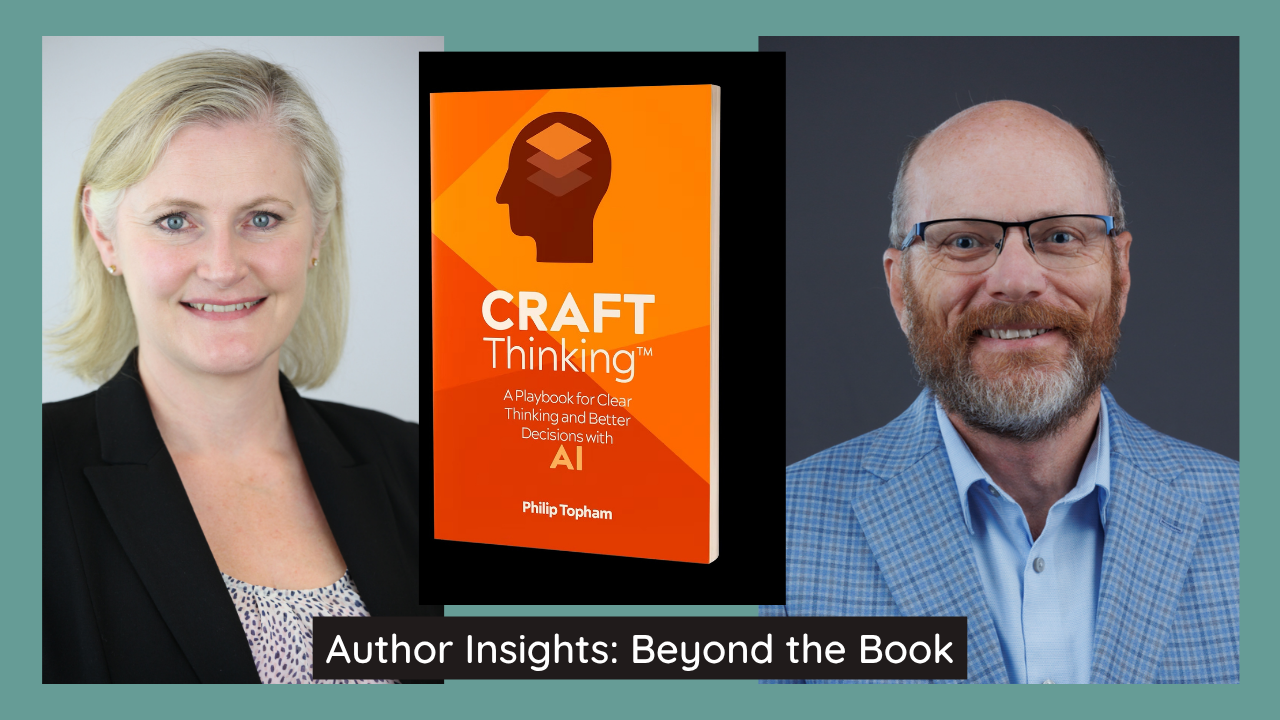
🎥 Watch the full interview
The Real Problem With AI Isn’t the Technology
One of the most confronting ideas from the conversation is simple:
The problem isn’t AI. It’s how we think.
Leaders are approaching AI the same way they approached previous technologies—tools for efficiency.
- Faster reports
- Faster analysis
- Faster execution
But AI is different.
It doesn’t just automate work. It interacts with cognition itself—how we interpret, question, and decide.
This is where AI leadership thinking starts to diverge from traditional leadership capability.
Why Faster Isn’t Better (And Often Worse)
There’s a growing assumption in organisations that speed equals advantage.
But faster thinking is not the same as better thinking.
When leaders rely on AI for rapid answers:
- They skip context
- They accept the first answer
- They reduce critical evaluation
The result?
Decisions feel confident—but are often under-tested.
As discussed in the interview, the real discipline is:
Slow down to speed up
Clarity before acceleration.
The First Answer Problem
One of the most practical insights from the discussion is this:
The first answer from AI is seductive—and dangerous.
Why?
Because it is:
- Well-written
- Confident in tone
- Immediately usable
And that creates a cognitive trap.
Leaders stop there.
But strong AI leadership thinking requires something different:
- Asking: What’s wrong with this?
- Testing: Who would disagree?
- Exploring: What are the unintended consequences?
This is where AI shifts from tool to thinking partner.
From Productivity Mode to Leadership Mode
Most organisations are still using AI in productivity mode:
- Reduce headcount
- Automate tasks
- Cut costs
But this is a narrow lens.
The real opportunity is leadership mode:
- Expanding strategic thinking
- Exploring new markets
- Pressure-testing decisions
- Seeing second- and third-order impacts
This is a fundamentally different posture.
And it requires a shift in how leaders engage with AI—not just what they use it for.
The CRAFT Thinking Framework (Simple, Practical Structure)
To support better thinking, Philip introduces the CRAFT framework:
- Context – What situation are we in?
- Role – What perspective should AI take?
- Action – What do you want it to do?
- Format – How should the output be structured?
- Target – Who is this for?
At first glance, this looks simple.
But most leaders skip at least one of these—and that’s where outputs break down.
A useful way to think about it:
AI is like an intern with amnesia.
It’s capable—but only if you give it enough clarity.
Why Most AI Efforts Fail in Organisations
A critical point from the conversation is that many AI initiatives fail—not because of the technology, but because of how they’re implemented.
Common issues include:
- Treating AI as a pure technology project
- Delegating it solely to IT or the CTO
- Focusing only on “low hanging fruit”
- Ignoring decision-making complexity
AI is not just automation.
It introduces probabilistic thinking into systems—meaning:
- Outputs are not always fixed
- Judgment is required
- Oversight becomes essential
This is why AI leadership thinking cannot be outsourced.
AI Is Already Inside Your Organisation (Whether You Like It or Not)
Even when organisations delay formal adoption, employees are already using AI tools:
- ChatGPT
- Claude
- Gemini
Often without governance.
This creates a tension:
- Move too fast → risk and inconsistency
- Move too slow → loss of competitive advantage
Leaders are now operating on what one analogy described as:
A treadmill where someone else controls the speed
You don’t choose the pace.
You choose how you respond to it.
The Future: AI as a Thinking Partner (Not Just a Tool)
Looking forward, one of the more provocative ideas is the concept of digital twins:
- AI systems that mirror how you think
- Assist in decision-making
- Challenge your assumptions
Not to replace leaders—but to sharpen them.
In practice, this means:
- Using AI to test ideas before acting
- Simulating stakeholder reactions
- Exploring multiple futures
This is where AI leadership thinking becomes a competitive advantage.
What Thinking Well With AI Actually Looks Like
At its best, using AI well doesn’t feel like speed.
It feels like clarity.
“I hadn’t thought about that.”
That moment—when a blind spot becomes visible—is where the real value sits.
Not in faster answers.
But in better questions.
Final Thought
AI will not replace leadership.
But it will expose weak thinking.
And in a world where everyone has access to the same tools, the differentiator is no longer the technology.
It’s how well you think with it.
🔗 Resources
- Watch the full interview above
- Book: CRAFT Thinking – Philip Topham
- Connect with Philip (LinkedIn)
About Philip Topham:
Philip Topham is a strategic AI advisor, speaker, and creator of the
CRAFT Thinking™ method—a framework designed to bring clarity,
intentionality, and better decision-making into the AI era.
About Ros Cardinal:
Rosalind Cardinal is a leadership strategist, author, and founder of Shaping Change, an award-winning consultancy helping leaders and organisations build cultures where people and performance thrive. With a background in organisational development and neuroscience-based coaching, Ros works with boards, executives, and teams to create lasting change through clarity, courage, and connection.
Book a chat with Ros.
Read Next: When Being Competent Is Not Enough to Lead