
When Good Work Stops Working
At some point in your career, something shifts.
You’re still capable. Still delivering. Still doing work that matters.
And yet, your influence becomes… unpredictable.
Some ideas land immediately. Others drift past without traction. Occasionally, someone else says the same thing, and suddenly it’s heard.
It’s subtle at first. Easy to dismiss. But over time, it becomes harder to ignore.
And almost instinctively, the explanation turns inward.
Maybe you weren’t clear enough. Maybe you need to communicate better. Maybe it’s confidence.
This is the moment many capable professionals, especially women, misread what’s actually happening.
Because the issue isn’t always how you’re performing.
Often, it’s the system you’re performing inside.
The Shift No One Explains
Early in your career, the rules are relatively clean. If you work hard, do good work, and show up consistently, things tend to move.
Effort translates into outcomes.
But as you move into more complex environments, those rules quietly change.
Decisions become less linear. Power becomes less visible. Influence is no longer driven by effort alone, but by how that effort is interpreted – and whether it can move at all.
This is where many leaders get stuck. They keep doing what worked before, only to find that it no longer produces the same results.
Not because they’ve become less capable.
But because they’re now operating in a different game.
The Influence Equation
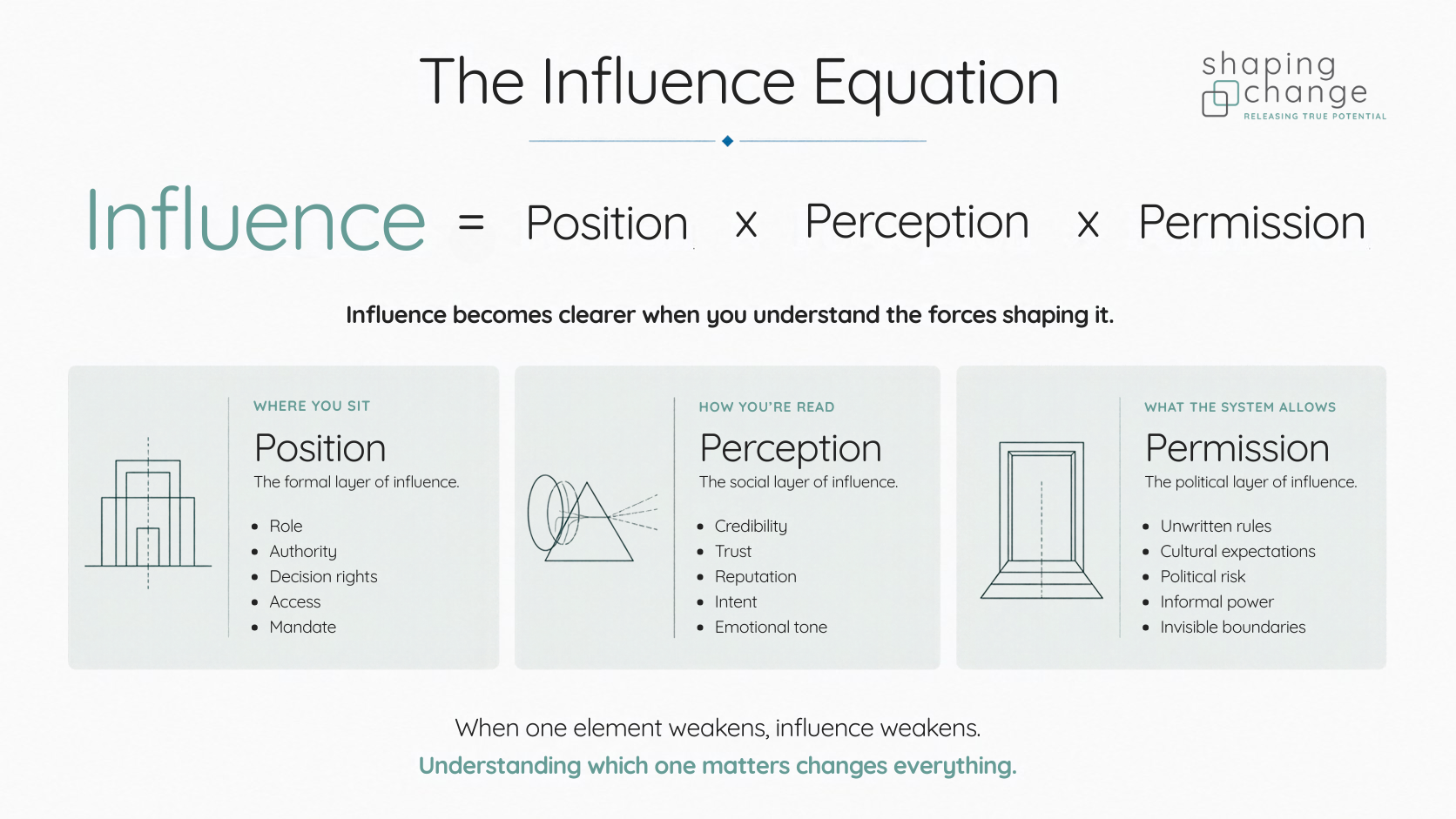
To make sense of this, I use a simple model:
Influence = Position × Perception × Permission
At first glance, it looks almost too simple.
But it explains something most leadership models don’t: why influence can collapse even when nothing about your capability has changed.
The key is multiplicative, not additive.
If any one of these drops out, the whole equation fails.
That’s why you can be credible, prepared, and articulate, and still not be heard.
Three Layers Most People Never See Together
Position is the most visible layer. It’s the formal structure – your role, your authority, your access. It defines what you are officially allowed to do.
But authority doesn’t guarantee influence. Many people have the title and still can’t move things forward.
Perception sits underneath that. It’s how people read you in the moment – your credibility, your intent, your presence. It explains why two people can say the same thing, and only one is heard.
And then there’s Permission.
This is the layer most people feel but rarely name.
It’s the set of unwritten rules that determine who is allowed to say what, challenge what, and push where – without consequence.
It’s where culture, identity, and power intersect.
And it’s where influence most often breaks.
A Pattern You’ve Probably Experienced
A leader presents a strong, well-considered proposal. The data is sound. The recommendation is clear. The thinking is solid.
But the response is… off.
People ask questions that don’t quite land. The conversation drifts. Nothing moves.
Afterwards, the natural conclusion is that something in the delivery needs work. So the next time, more effort goes in. The slides are sharper. The argument is tighter. The preparation is deeper.
And still, nothing shifts.
From the outside, it looks like a communication problem.
But often, it isn’t.
Sometimes the real issue is that the decision-maker isn’t in the room. Or the group isn’t willing to engage because the authority to act sits elsewhere.
In that case, no amount of refinement will change the outcome.
Because the wrong lever is being pulled.
The Trap of Self-Correction
When influence doesn’t land, most people try to fix themselves.
They become more careful. More considered. More precise. They adjust tone, language, delivery – sometimes endlessly.
And while those adjustments can help, they don’t always address the real issue.
Because sometimes the problem isn’t how something was said.
It’s whether it could be said at all.
When the conditions around influence are misread, effort gets applied in the wrong place. And over time, that becomes exhausting.
Reading the System Instead of Fixing Yourself
The real shift happens when you stop asking, “How do I do this better?”
and start asking, “What’s actually happening here?”
That question opens up a different line of thinking.
Is this about authority?
Is it about how I’m being interpreted?
Or is it about what the system will tolerate from me?
Each of those requires a different response.
If it’s position, the work is about alignment – getting the right people involved, clarifying decision rights, anchoring to authority.
If it’s perception, the work is about interpretation – how the message is framed, when it’s delivered, and sometimes who delivers it.
And if it’s permission, the work becomes more strategic. It’s about building cover, shifting conditions, and expanding what’s possible over time.
That’s where influence becomes less about performance – and more about navigation.
The Part Most Leadership Advice Misses
Most leadership advice focuses heavily on confidence, communication, and presence.
In other words, perception.
Some of it addresses position – clarity of role, decision-making authority, structure.
But almost none of it addresses permission.
And yet, permission is often the deciding factor.
It’s what determines whether a behaviour is accepted, ignored, or penalised. It explains why the same action can be rewarded in one person and challenged in another.
Without understanding this layer, people keep trying to improve themselves – when the constraint isn’t personal.
It’s political.
What This Changes
Once you can see these three layers clearly, something shifts.
Moments that used to feel confusing start to make sense. Resistance becomes data, not rejection. And instead of defaulting to self-doubt, you can choose a response that actually fits the situation.
That doesn’t mean influence suddenly becomes easy.
But it does become more deliberate.
The One Thing Worth Holding Onto
If you take one idea from this, let it be this:
Influence isn’t about trying harder.
It’s about understanding the system well enough to act strategically within it.
Because when you can see what’s really happening –
Position, Perception, and Permission stop being abstract concepts.
They become levers you can actually use.
A Question to Leave You With
Think of a recent moment where your influence didn’t land.
If you look at it now, through this lens –
what was really in play?
And what would you do differently if you didn’t assume it was about you?
About the Model
The Influence Equation is part of a broader body of work in Political Intelligence and Adaptive Influence, developed to help leaders navigate complexity, power, and organisational systems more effectively.
If you want to go deeper into how influence works in your environment, you can explore the Political Intelligence Compass™ – a diagnostic designed to map both your influence style and the system you operate within.
About the Author
Rosalind Cardinal is a leadership strategist, author, and founder of Shaping Change, an award-winning consultancy helping leaders and organisations build cultures where people and performance thrive. With a background in organisational development and neuroscience-based coaching, Ros works with boards, executives, and teams to create lasting change through clarity, courage, and connection.
Book a chat with Ros.
Read next: Why Silence in Leadership Meetings is Rarely Neutral